But this had happened before, and I knew what to do. Awhile ago, I first read Unconditional Parenting, by Alfie Kohn, and marveled at the mind-blowing I received. I discovered there was an Unconditional Parenting DVD, which our library carried. Bingo! It was absolutely perfect. It translated the main points of the book into a limited-timeframe format. Sam enjoyed it so much that he recommends the DVD to other parents without the energy to add another book to their reading list.
Please note that I am not faulting Sam for this. When I enjoyed In Defense of Food, I subsequently checked out Michael Pollan's longer tome, The Omnivore's Dilemma. I checked it out about six times and never got past the intro. At 464 pages, it just wasn't happening.
So I understood the reluctance to dive into a book, for whatever reason. But to share my experience with Sam, was there a companion DVD to In Defense of Food? Well, sorta.
King Corn, directed by Aaron Woolf, is a documentary that follows two school friends, Ian Cheney and Curt Ellis, from East Coast city life to the fields of Iowa, where they pursue a dream to grow one acre of corn and then track where that corn ends up. They basically want to see if it's true, as Michael Pollan and other food gurus contend, that corn is as ubiquitous a part of the American (or, broadly speaking, the Westernized) diet as they say it is.
Short answer: yes.
We have switched from being omnivores who eat real, whole food, to being consumers of processed, food-like substances, and in all of our meals corn and soy reign supreme. (Soy doesn't get as much mention in this film, what with the title of King Corn and all, but it's becoming just as insidious.)
If you're like me and you have something processed handy (a bag of Cheetos, say, or a bottle of ketchup), go and grab it and see if you can find the corn and soy that are abundant within its hallows.
Here are some words that can mean corn is present: anything with the word "corn," such as corn flour, cornstarch, corn gluten, corn syrup, corn meal, high fructose corn syrup; but then also such seemingly innocuous entities as baking powder, caramel coloring, confectioner's sugar, malt, starch, modified food starch, treacle, vanilla extract, vegetable protein, and vegetable shortening; as well as such chemically obtuse ingredients as dextrin, maltodextrin, dextrose, fructose, monoglycerides, diglycerides, MSG, sorbitol, sucrose, and xantham gum.
And here are some that indicate soy: anything with the word "soy," such as soybean oil, isolated soy protein, soy protein concentrate, soy isoflavones, etc.; lecithin; hydrolyzed vegetable protein; textured vegetable protein; margarine; teriyaki; and my favorite, natural flavors; among others!
But forgetting specific ingredients, what King Corn demonstrates is that corn is even more widespread than that. Corn is present in beef, for instance, because cattle in feed lots are fattened on corn meal instead of their natural food of grass. Corn makes an appearance in pesticides and packaging; its oil fries up our fatty foods; and we even fuel our cars with corn-derived ethanol. The government subsidizes corn growing, and keeps thinking up new ways to grow more — and then use up — this one crop.
To make a people of corn, our country has become corn-reliant. The movie shows, in cute stop-animated motion featuring the Fisher-Price farmhouse I remember from my youth, how farmland has been swallowed up by corn, and how farms have gone from variety to monoculture, from family-owned to corporate.
For all that, King Corn is rather gentle in its rhetoric. It's not out to make the Iowan farmers feel bad. I really appreciated the way Cheney and Ellis spoke courteously with everyone in their new town and listened to the stories around them. It turns out that the corn farmers already know there's something wrong with the priorities in food growing, but it's one of those complicated situations where it isn't easy to figure out what the "right" thing to do is and, then, how to accomplish it. The guys grow their corn the way the other Iowans are doing it, with loads of fertilizer and pesticide, and using the standard strain that's become widespread throughout the Midwest, but it's unclear if growing it organically would make a difference, or would change the outcome.
In one scene, the filmmakers try eating one of their freshly grown ears of corn — and they spit it out in disgust. What's taking over America's heartland isn't the sweet corn you buy to grill up with butter and salt for Fourth of July, and it's not one of the many varieties that were once natively grown on this soil in the pre-Pilgrim days. It's inedible food-processing material, fit only for animals who can't choose better for themselves and for disguising through chemical processes into some form of food-ish product.
Because the guys can't gain entrance into any high-fructose corn syrup manufacturing plant, they finally get someone to tell them the recipe over the phone. It's a horrifying concoction that includes unfamiliar enzymes and requires face masks and gloves to create. It's about as far from "cooking" as you can imagine. At the end of it all — a sickly sweet syrup. That syrup goes into almost every processed food out there, not just things we typically think of as sweets, but even things like breads and condiments and toothpaste.
I recommend this film as a good intro into the ideas of In Defense of Food or Weston A. Price — the general idea that Americans are not eating right. The film doesn't go much into what Americans then should be eating, but it's probably pretty easily guessed: real, whole, unprocessed food. That doesn't allow, of course, for the fact that some of what seems to be just that is actually processed food in disguise, such as our meat that comes from corn-fed, antibiotic-injected animals or our produce that comes from pesticide-sprayed, genetically modified fields. That's where paying attention to the origins of foods comes into play, and where eating what's termed a "traditional foods" diet can help.
I'd like to talk more about traditional foods in the future. I read about one blogger who did a traditional foods challenge, eating only foods that your great-great-grandmother would recognize as food, for a month. I wanted to do the same and picked July as my target, since we had parents visiting in June and August. I figured our summer was going to be pretty relaxing, so I'd have plenty of time to soak beans and simmer grains. And then we decided to buy a house, and everything just went all stupid. We've been stressed and haven't had much time to cook; we're trying to use up what's in the pantry and freezer before we move; and we keep turning to comfort foods to wallow. When I write about these issues of eating good foods, I want to confess right now that I am no hero of the movement. I am learning and wishing and rather pathetically trying. I figured at some point that I'd share more of that journey with you.
Remember how I said that, in the end, the situation was complicated? The filmmakers have to decide what to do with their own little one-acre harvest, in much the same way that each of us has to decide what to eat and what to promote with our grocery dollars. But it all feels like a very little drop in the bucket when it comes to influencing the government's obsession with corn, or the culture's addiction (and my own) to cheap, convenient, tasty food.
Next up is changing my own habits before tackling the world's... But, first, a couple more DVDs to watch. I really enjoyed Super Size Me, and The Corporation is what convinced me to switch to organic milk if nothing else; if you're looking for something more hard-hitting, try these. I'm interested in seeing Food, Inc., but unfortunately our library doesn't carry the DVD, only the Participant Guide.
Still, maybe I've seen enough now to convince me. Our plan when moving into our new place is to transfer only worthy foods, and anything that is purchased for it must be equally sanctioned. Sometimes it's best to make a clean break, right?
Time to dethrone corn and regain my status as an omnivore.
So all those naysayers who said it's unnatural and degrading to encourage children to play at breastfeeding — there ain't nothin' you can do to stop it.
Things have been stressful in house-buying land, and I haven't felt up to writing about it, or about anything really, preferring to wallow in my discouragement. Everything else has been worked out so far, and we're hung up on one minor budgeting snafu that's up to the property manager to work out — only she won't return phone calls and doesn't seem able to read a spreadsheet. A spreadsheet that she put together in the first place. Oy.
To that end, I wanted to find something to post about that wouldn't make me sad. And I thought — breastfeeding photos! Beautiful breastfeeding photos.
When I was looking for images to use for my week of breastfeeding posts, I found so many wonderful breastfeeding photographs that I couldn't find a place for. So I thought I'd round some up here and let you enjoy them, too.
It's sort of like a Wordless Wednesday post, only it's Friday, and there are more words...
"This is what a nursing toddler looks like" is from sarah-ji on flickr. Here is her blog post about extended breastfeeding called "out of the EB closet," and her reasons to post the picture are on her flickr page. I'm so glad she did. Mikko's over 2 years old now and still nursing, and I love seeing other mamas with nursing toddlers for the support and camaraderie. It's definitely not abnormal as a species or historically, but for this culture, yeah. Here are Sarah-Ji's reasons to go public:
"I was originally going to keep this photo private, but i decided that we need more images of nursing toddlers in our society to normalize not only breastfeeding in general, but extended breastfeeding as well. i'm no militant lactivist, but the nursing relationship has been a very tender and rewarding experience for me and cadence, especially since i work full-time outside the home."
This photo is titled "Post partum," and it just speaks that perfectly for me. That mix of bewilderment, love, exhaustion, exhilaration, and "What were we thinking??" And I do believe that's a Boppy nursing pillow there under her sweet baby. It looks like she's got it balanced on the arms of her chair, which is what I often did as well. Via 3rd Wheel at flickr.
I love "Lunch At The Zoo" by Brave Heart (flickr) for its extreme stripiness! It's like seeing very colorful tigers. I'm also liking her wrap, which looks like a nice stretchy wrap for a newborn. Trips to the zoo are so much fun when you're carrying your own little creature through!
Here's another great one for extended nursing called "Nursing Charles on the train" from rmcf28 on flickr. I love how Charles is making a tent out of his mother's shirt — he's got his whole arm up there! This is one sure way to make a train ride nice and cozy for everyone.
"Beth & Laurel (mid-feed)" from moppet65535 on flickr gives a great example of side-lying nursing, which is the lifesaver of every breastfeeding cosleeper. In the interests of safety, please note that I am not (and this picture is not) endorsing the parent falling asleep on the couch as safe cosleeping. But do see how side-lying nursing can help you relax and put your feet up even when you're not sleeping!
I don't even know what the nursing pillow is in "Breastfeeding" by Marc van der Chijs on flickr, but check it out! It's as big as a loveseat cushion, and it looks like it's wrapping around her. Any guesses?
Thank you for joining me in Hobo Mama's observance of World Breastfeeding Week: August 1-7, 2009. It's been wonderful to celebrate breastfeeding with all of you! I've so appreciated your thoughtful comments and the chance to visit your blogs and hear your thoughts on breastfeeding as well.
Here's one last post to wrap it all up.
*******
If you're new to Hobo Mama or want to catch up on some articles having to do with breastfeeding, here's a roundup of some of my best breastfeeding posts, indexed by category. Some will repeat if they fit in multiple categories, but this way you'll be able to select a specific topic of interest to you to read about. The posts are listed within each category in reverse chronological order, most recent at top.
If you're reading this past the day it was posted, feel free to use the general breastfeeding label search to find any new posts and any I might have missed.
Feel free to let me know if any links are broken or if you want to suggest different topic groupings. Also feel free to suggest new posts on specific topics!
This post is a continuation of Hobo Mama's celebration of World Breastfeeding Week: August 1-7, 2009.
*******
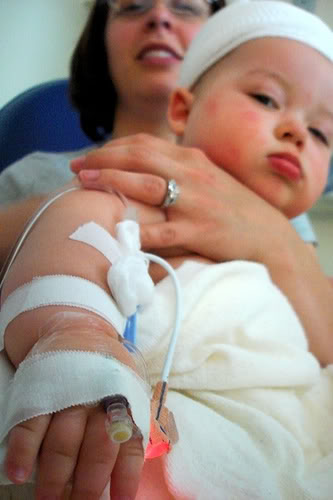
Mikko had to have a minor surgery when he was around a year old, to search for what appeared to be an undescended testicle. Because of his age, even minor surgery required major anesthesia, so he was going to be put under entirely.
Therefore, we were given the standard protocol for "nothing by mouth" for a certain number of hours before surgery, to avoid aspiration of stomach contents while Mikko was unconscious. We were told Mikko could have no solid food for 12 hours before surgery, no breastmilk for 8 hours, and then only clear liquids (water and pulpless juice like apple) up until 4 hours before. The surgery was scheduled for early morning, theoretically to assist us in keeping him unfed.
But we had a baby who was interested in one food only, particularly at night: breastmilk. What on earth were we going to do to get a preverbal, cosleeping infant through eight long hours with no nummies? In fact, the hospital kept telling us our son could hold onto any favorite comfort item, such as a favorite blankie or stuffed animal — we wondered if it would be possible to do a quick removal and send my breasts along with him into the operating room.
"Many times, when baby is scheduled to undergo surgery, the mother is told 'no breastfeeding after midnight the night before surgery' or 'no breastfeeding less than 8 hours prior to surgery.' Many moms are understandably concerned about this, since withholding nursing from a baby or young child for this amount of time will frequently result in a miserable time for all concerned. Not only is baby hungry, but mom and baby's most useful comforting tool — nursing — is also gone."
"Understandably concerned," I started doing some research about whether our hospital was following the recommended NPO strategy for breastfed infants — and found that those guidelines have been heavily revised, in favor of allowing breastmilk closer to surgery.
If you look at the preoperative fasting guidelines from no less a body than the American Society of Anesthesiologists — surely a group knowledgeable about anesthesia if ever there was one — you can see that recent guidelines are much more liberal. Here is a summary chart of the NPO guidelines, and here is the longer PDF version from the society itself.
You can see that, for a healthy individual undergoing elective surgery (as was our little Mikko), the new guidelines are as follows: Babies can have a light meal of solid food up to 6 hours beforehand, formula or non-human milk also 6 hours before, breastmilk 4 hours before, and clear liquids up to 2 hours beforehand.
The hospital handouts I received, as well as the doctors and nurses I spoke to, were very clear that breastmilk was not considered a clear, easily digested liquid, and so it must not be ingested more than 8 hours before surgery.
This is not a big surprise, considering this article from the American Journal of Nursing, aptly titled "Preoperative fasting: old habits die hard." Basically, experts review and revise their guidelines and try to disseminate the new information, but it takes a long time for it to trickle to everyone who needs to know. You'll notice this if you have considered giving or have given birth in a hospital — you'll have read in book after book that, say, episiotomies and male circumcision should no longer be routine — but unless you're very fortunate, the hospital will still try to do them as a matter of course.
The reason that breastmilk should not be lumped into the same category as solid food, or even formula, is that it is very easily digested. Breastmilk is relatively low fat, which is why human babies eat so frequently. Some research suggests that babies could actually breastfeed even closer to surgery, but four hours is considered conservatively safe. Part of the confusion among hospital staff is in how to classify breastmilk — it's not a solid, and it's not even as food-like as cow's milk, and yet it does typically take longer to digest than clear water or apple juice. (Kellymom has a great article with references to research on the issue of preoperative fasting and different hospitals' guidelines.) Even the old recommendations regarding solids (12 hours or more vs. 6 hours now) have been revised because of improved anesthesia since the first guidelines became standard — and yet the outdated guidelines persist in so many hospitals.
I tried to get some advocacy from Mikko's pediatrician on the matter. I thought maybe if she'd read the new guidelines she would agree with me that the hospital's guidelines were unnecessarily restrictive — and even traumatic — to an infant facing surgery and separation from his parents. But she was no help at all, because her mother had just died from aspirating during surgery. I felt like such a heel for bringing it up. Especially because she'd told us about her mother's recent death before and I'd forgotten, so this was the second time I'd brought it up! Funnily enough, she also guilted us into the surgery in the first place because her husband had had the same condition — only, he had two undescended testicles — and his mother had put off the surgery until he was in elementary school, with the consequence that he was permanently infertile! We seriously couldn't win; any quibble we had our pediatrician could meet with a (true) horror story!
So there was no help there. I had tried bringing up my reservations with the NPO restrictions on breastmilk with the surgical staff and met with no success there, either. I resolved to write a letter after the surgery suggesting that the hospital abide by the ASA's new guidelines, especially with regards to breastmilk. It's particularly significant at this hospital, because it's a children's hospital, so there are a lot of nursing infants undergoing surgery there, unnecessarily being kept unfed for twice as long before surgery as is required for safety.
It's especially difficult because breastfeeding itself, not just the ingested breastmilk, is a comforting mechanism for babies in distress — such as a baby undergoing surgery. By the time we were checked in for the surgery, having been made to wait in a loud room with bright lights and strange faces for quite some time, Mikko was frantic and nursing would have done a lot to calm him. One solution that astute anesthesologists have suggested is allowing comfort nursing on a pre-pumped breast. The baby would still receive some milk, but not a full meal's worth. This, of course, was not allowed us at the hospital that forbade breastfeeding at all for 8 hours prior!
I won't tell you exactly what we chose to do in terms of preoperative fasting for our baby's surgery, because I don't want anyone blaming me for dispensing medical advice against the counsel of physicians. If, however, your nursing baby is undergoing surgery, please use the resources I've linked to to speak with the surgical staff or your pediatrician about acceptable preoperative breastfeeding guidelines. If your hospital, like mine, insists on following outdated restrictions, write a letter and send along the ASA's revised recommendations.
I can say this, even though I haven't written my letter more than a year later... But I will. Honest.
I haven't spoken in this post about how wrenching it felt to choose surgery for a young one, or how it was to sit through it — and this a minor, elective one, at that! Fortunately, in the end, we were well taken care of by the hospital besides the preoperative guidelines. A receptionist was delighted to lead me to their new, private pumping room while Mikko was away from us and I felt about to burst. And, then, immediately after Mikko came to, the staff brought him into a private room where I was able to nurse him in his drowsy state. Sam turned off the lights, and we three sat there for over an hour, with nobody disturbing us, but just letting Mikko breastfeed and wake up at his own pace, comfortably cradled in his mama's arms.
If you can get your hospital to agree to nothing else regarding breastfeeding and surgery, I hope you can get them to agree to that!
"Some mothers find it helpful to schedule the surgery so that they can take advantage of a 3-4 hour length of time when their baby or toddler is fairly content without nursing. For example, if the NPO period is 3 hours, then baby could nurse through the night until 7 a.m., get up early, and then play with mom or dad until the scheduled surgery time of 10 a.m. It may be easier to skip breakfast and to distract a child from nursing in the morning than it would be to keep the child from nursing through the night."
This would be particularly helpful for cosleeping infants, since the milk bar is so conveniently close and mama so groggily unaware in the early morning hours. (I know whereof I speak.) So you might suggest to the surgical schedulers a timing that works for your little one instead of taking the typical route of the earliest surgery possible for young children.
Another tip, if you are having an early morning surgery, is to try what we did, which worked better than we had feared. We kept a cup of apple juice and one of water on the nightstand. When Mikko woke up during the night, Sam took care of him and gave him juice or water to drink. Since Mikko usually gets up in the late morning, waking him up for an early surgery meant he was still so groggy that he wasn't himself enough to demand breastfeeding. Sam got him ready to go, the better to keep him away from temptation, and then we quickly bundled him into the car. Sam and I had gotten ready before waking him so that the time from waking Mikko to leaving was a matter of minutes. It was waiting in the waiting room and then the interior waiting room that was the hard part, but fortunately there were new sights to distract him for a lot of the time. I was able to hug and cuddle him and try to distract him with playing. Only for the last twenty minutes or so did we have a total meltdown, before the nurse helped us force a sedative into him. He had had enough of waiting and being hungry and thirsty by that point.
Now, I want to be clear, in case you think I'm advocating recklessness, that it's better safe than sorry when it comes to surgical complications. That's why I recommend you speak with the surgical staff and your pediatrician if you're concerned about the preoperative guidelines rather than just decide on your own. That way you can ask if they're familiar with the new anesthesia recommendations for breastmilk and other foods and find out why they're counseling you the way they are. It might be that your particular child has a medical condition that requires a longer lead time to digest food or breastmilk, or that there's something particular about the specific anesthesia that will be used. And, of course, if your baby is taking in formula or solid foods, note that the lead time is longer for those than for breastmilk.
In case you were curious, Mikko's surgery was uneventful. It turns out there was no undescended testicle, just one that had died sometime during the birth or right around then. He's not at increased risk for cancer, but he will be wearing a cup for all sports to protect the remaining side. I have mixed feelings about whether we did the right thing even to go ahead with the surgery, but there was a chance that there was a second testicle that could have been saved. For all the agony I went through with this surgery, Mikko had the recovery typical of young children: fast, with no ill effects. The only thing that ticked him off was our trying to force pain medicine down him! It seriously was harder than pilling our cat, and that's saying something. (Why do they make children's liquid medicine bright, staining red??) In any case, he was very grateful to be nursing again without restriction!
*******
Here again are links regarding preoperative fasting as it relates to breastmilk:
"The infant who is hospitalized is already traumatized by the separation, the strange surroundings and people, and the underlying discomfort of the disease process itself. If the infant is to be fed orally, feeding should be at the breast as often as possible... The infant should not be subjected to the added trauma of being weaned from the breast when the infant needs the security and intimacy of nursing most...."
Best wishes to you as you advocate for your nursing child during what can be a very stressful situation, and quick healing to your little one.
This post is a continuation of Hobo Mama's celebration of World Breastfeeding Week: August 1-7, 2009.
*******
Sam runs across funny tidbits like this as he surfs the internet for fodder for his own hilariously eclectic blogging. It fit with this week's breastfeeding theme, so I will present it to you here.
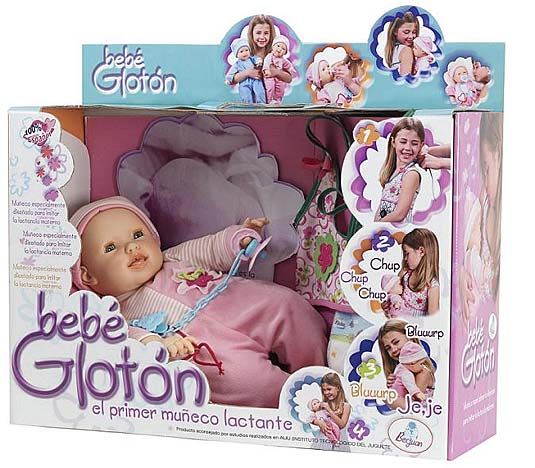
A Spanish company has produced the first breastfeeding doll, Bebé Glotón, which I understand is supposed to be an affectionate term translating into the rather flat "gluttonous baby" in English.
There's a lot of controversy (natch) about this doll, so I can't even get to the official site above there because the bandwidth has been exceeded. Don't worry, though, you can see it on numerous other websites, filled with comments and commentary that appreciate or lambast (mostly the latter) the dollmakers.
Fox News (of course) finds it in questionable taste to allow young girls to play at breastfeeding. "The halter top has daisies that cover the little girls’ nipples and come undone just as easily as the flaps of a nursing bra would," says the article, which makes it sound smutty indeed. What Fox doesn't seem to understand about how the doll works is that the girl does not remove the halter, or indeed wear it au naturel; the daisies on the halter are supposed to represent the breasts, and it's when she puts the baby to these flowers that the doll stops crying and starts makes sucking noises. (On the package it's an adorably onomatopoeic "Chup chup chup.")
Fox also has the audacity to suggest that playing at breastfeeding is going to lead to skyrocketing cases of teen pregnancies, because girls will be unable to resist the "maternal urges" to have their own nursling. Well, I'm here to tell you that when my little brother was born when I was 9 years old, I played at nursing my dolls — there wasn't any fancy-dancy noise or motion, and I just lifted my shirt like my mother was doing with my baby bro — and I did not have my first child until I was 31, after having been married for 9 years. So clearly, playing at breastfeeding does not inescapably lead to unwanted teen pregnancy. What it does do is normalize breastfeeding and inspire girls to give it a try for real when they are mature enough to become mothers.
All right, so much for Fox's fair and balanced coverage. How about this "comedy" post by New Jersey columnist Eric Ruhalter? He scoffs at the idea of showing breastfeeding as natural: "I don't think any mom (pre-teen or otherwise) is contesting the fact that breastfeeding is healthy and natural. I think it's the clogged ducts and the cracked nipples that put them off." Then he echoes the fearmongering that playing at breastfeeding is going to induce unwanted pregnancies. (I'm sorry, but isn't it very young girls who play with dolls? By the time I was nearing puberty, my dolly days were over.) Then he finishes up with suggesting a range of other "what will they think of next!" dolls: "Bebe Sot - The doll who has a problem with a different kind of bottle, and loses his family, job and feelings of self worth? ? Bebe Limp - The male doll who experiences erectile dysfunction? Bebe Cell Mate - A weak unimposing doll that experiences all the indignation and humiliation of life in prison." Yes, let's compare breastfeeding with anal rape, shall we?
This post at Thingamababy is actually unbiased and informed. Not so all the comments, which are a bit painful to read through. Basically, there are those who think it's admirable in that it does away with the standard baby-bottle accompaniment and promotes breastfeeding, those who think it's unnecessary because any old doll can be pretend-breastfed by simply lifting a shirt (true, and cheaper), those who think that breastfeeding is sexual and so offering a breastfeeding doll with a halter is sexualizing young girls and turning them into tramps (Uhmmm...), and those who think it's just plain weird. Well, ok, I can see the point of all but the sexualizing. I also like that a lactation consultant wrote in to say that the latch should be wider. It really should.
This Associated Content post brings up another concern that some have had about this doll: Are we excluding boys from playing with it? I don't think so. If a boy is young enough to feel unashamed about playing with dolls in this culture, he's young enough not to understand and/or care about the difference between what mothers can do and what fathers cannot. I mean, I don't want to speak for every boy out there, but my experience watching boys play with dolls has been that (a) they're very young and (b) they don't think too hard about it. Actually, my 2-year-old tends to bring his dolls to me to breastfeed them, because that's what makes the most sense to him. I suppose if he were old enough to understand the function of the Bebé Glotón and want to play with it, he might either experiment with the halter himself, or bring it to whatever girl is playing the mother! Couldn't that be just fine, too, for boys to play at fathering by handing a crying "baby" to the mother to feed, and then walking and shushing the infant afterward? Works for me.
What's your take on the doll? I can take it or leave it as a doll, but I like it for what it represents. Apparently breastfeeding is becoming normalized enough that a manufacturer saw a way to make money off of it! All right, I didn't put it very well, but you know what I mean...
I'm Lauren Wayne, writer and natural parent. I embrace attached parenting with an emphasis toward green living.
Riding the rails with my husband, Crackerdog Sam, and our hobo kids, Mikko Lint Picker (born June 2007), Alrik Irontrousers (born May 2011), and Karsten (born October 2014). Trying every day to parent intentionally and with grace.

 , by Michael Pollan — "In Defense of Food: Growing your own" and "In Defense of Food: Nutritionism and breastfeeding." In my enthusiasm over the book, I've quoted and recapped pretty much the whole thing to my husband. Although Sam seemed intrigued, it didn't inspire him to crack open the book himself.
 , by Alfie Kohn, and marveled at the mind-blowing I received. I discovered there was an Unconditional Parenting DVD
 , which our library carried. Bingo! It was absolutely perfect. It translated the main points of the book into a limited-timeframe format. Sam enjoyed it so much that he recommends the DVD to other parents without the energy to add another book to their reading list.
 . I checked it out about six times and never got past the intro. At 464 pages, it just wasn't happening.
 What I found was King Corn
 .
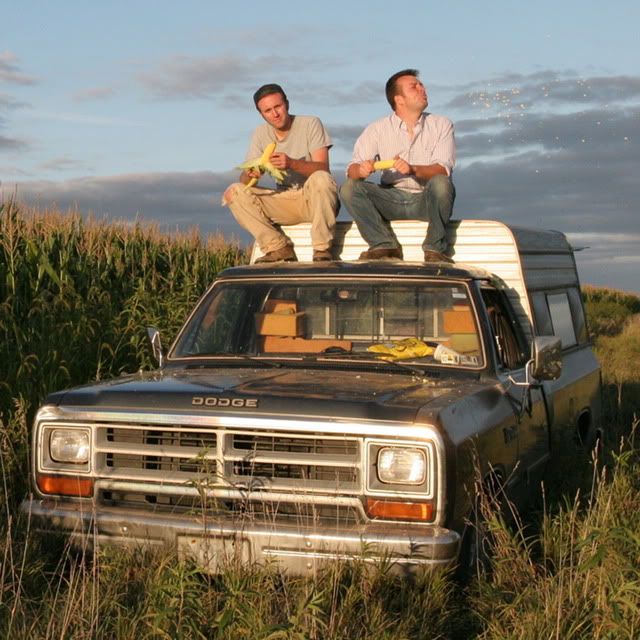 In one scene, the filmmakers try eating one of their freshly grown ears of corn — and they spit it out in disgust. What's taking over America's heartland isn't the sweet corn you buy to grill up with butter and salt for Fourth of July, and it's not one of the many varieties that were once natively grown on this soil in the pre-Pilgrim days. It's inedible food-processing material, fit only for animals who can't choose better for themselves and for disguising through chemical processes into some form of food-ish product.
 , and The Corporation
 is what convinced me to switch to organic milk if nothing else; if you're looking for something more hard-hitting, try these. I'm interested in seeing Food, Inc.
 , but unfortunately our library doesn't carry the DVD, only the Participant Guide
 .


 , by Drs. Ruth Lawrence and Robert Lawrence, which has this wonderful quote:


 I'm Lauren Wayne, writer and natural parent. I embrace attached parenting with an emphasis toward green living.


