This post is a continuation of Hobo Mama's celebration of World Breastfeeding Week: August 1-7, 2009.
*******
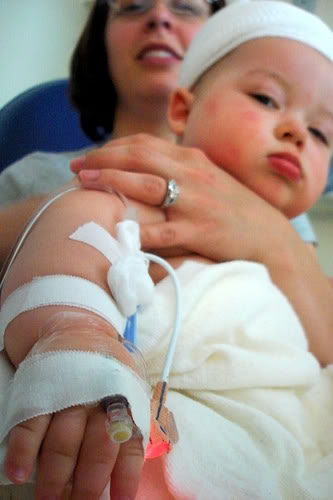
Mikko had to have a minor surgery when he was around a year old, to search for what appeared to be an undescended testicle. Because of his age, even minor surgery required major anesthesia, so he was going to be put under entirely.
Therefore, we were given the standard protocol for "
nothing by mouth" for a certain number of hours before surgery, to avoid aspiration of stomach contents while Mikko was unconscious. We were told Mikko could have no solid food for 12 hours before surgery, no breastmilk for 8 hours, and then only clear liquids (water and pulpless juice like apple) up until 4 hours before. The surgery was scheduled for early morning, theoretically to assist us in keeping him unfed.
But we had a baby who was interested in one food only, particularly at night: breastmilk. What on earth were we going to do to get a preverbal, cosleeping infant through eight long hours with no nummies? In fact, the hospital kept telling us our son could hold onto any favorite comfort item, such as a favorite blankie or stuffed animal — we wondered if it would be possible to do a quick removal and send my breasts along with him into the operating room.
As Kellymom says in
"Breastfeeding when baby has surgery":
"Many times, when baby is scheduled to undergo surgery, the mother is told 'no breastfeeding after midnight the night before surgery' or 'no breastfeeding less than 8 hours prior to surgery.' Many moms are understandably concerned about this, since withholding nursing from a baby or young child for this amount of time will frequently result in a miserable time for all concerned. Not only is baby hungry, but mom and baby's most useful comforting tool — nursing — is also gone."
"Understandably concerned," I started doing some research about whether our hospital was following the recommended
NPO strategy for breastfed infants — and found that those guidelines have been heavily revised, in favor of allowing breastmilk closer to surgery.
If you look at the preoperative fasting guidelines from no less a body than the American Society of Anesthesiologists — surely a group knowledgeable about anesthesia if ever there was one — you can see that recent guidelines are much more liberal. Here is a
summary chart of the NPO guidelines, and here is the
longer PDF version from the society itself.
You can see that, for a healthy individual undergoing elective surgery (as was our little Mikko), the new guidelines are as follows: Babies can have a light meal of solid food up to 6 hours beforehand, formula or non-human milk also 6 hours before,
breastmilk 4 hours before, and clear liquids
up to 2 hours beforehand.
The hospital handouts I received, as well as the doctors and nurses I spoke to, were
very clear that breastmilk was
not considered a clear, easily digested liquid, and so it
must not be ingested more than 8 hours before surgery.
This is not a big surprise, considering this article from the
American Journal of Nursing, aptly titled "
Preoperative fasting: old habits die hard." Basically, experts review and revise their guidelines and try to disseminate the new information, but it takes a long time for it to trickle to everyone who needs to know. You'll notice this if you have considered giving or have given birth in a hospital — you'll have read in book after book that, say,
episiotomies and
male circumcision should no longer be routine — but unless you're very fortunate, the hospital will still try to do them as a matter of course.
The reason that breastmilk should not be lumped into the same category as solid food, or even formula, is that it is very easily digested. Breastmilk is relatively low fat, which is
why human babies eat so frequently. Some research suggests that babies could actually breastfeed even closer to surgery, but four hours is considered conservatively safe. Part of the confusion among hospital staff is in how to classify breastmilk — it's not a solid, and it's not even as food-like as cow's milk, and yet it does typically take longer to digest than clear water or apple juice. (
Kellymom has a great article with references to research on the issue of preoperative fasting and different hospitals' guidelines.) Even the old recommendations regarding solids (12 hours or more vs. 6 hours now) have been revised because of improved anesthesia since the first guidelines became standard — and yet the outdated guidelines persist in so many hospitals.
I tried to get some advocacy from Mikko's pediatrician on the matter. I thought maybe if she'd read the new guidelines she would agree with me that the hospital's guidelines were unnecessarily restrictive — and even traumatic — to an infant facing surgery and separation from his parents. But she was no help at all, because
her mother had just died from aspirating during surgery. I felt like such a heel for bringing it up. Especially because she'd told us about her mother's recent death before and I'd forgotten, so this was the second time I'd brought it up! Funnily enough, she also guilted us into the surgery in the first place because her husband had had the same condition — only, he had
two undescended testicles — and his mother had put off the surgery until he was in elementary school, with the consequence that he was permanently infertile! We seriously couldn't win; any quibble we had our pediatrician could meet with a (true) horror story!
So there was no help there. I had tried bringing up my reservations with the NPO restrictions on breastmilk with the surgical staff and met with no success there, either. I resolved to write a letter after the surgery suggesting that the hospital abide by the ASA's new guidelines, especially with regards to breastmilk. It's particularly significant at this hospital, because it's a
children's hospital, so there are a lot of nursing infants undergoing surgery there, unnecessarily being kept unfed for twice as long before surgery as is required for safety.
It's especially difficult because breast
feeding itself, not just the ingested breastmilk, is a comforting mechanism for babies in distress — such as a baby undergoing surgery. By the time we were checked in for the surgery, having been made to wait in a loud room with bright lights and strange faces for quite some time, Mikko was frantic and nursing would have done a lot to calm him. One solution that astute anesthesologists have suggested is
allowing comfort nursing on a pre-pumped breast. The baby would still receive some milk, but not a full meal's worth. This, of course, was not allowed us at the hospital that forbade breastfeeding at all for 8 hours prior!
I won't tell you exactly what we chose to do in terms of preoperative fasting for our baby's surgery, because I don't want anyone blaming me for dispensing medical advice against the counsel of physicians. If, however, your nursing baby is undergoing surgery, please use the resources I've linked to to speak with the surgical staff or your pediatrician about acceptable preoperative breastfeeding guidelines. If your hospital, like mine, insists on following outdated restrictions, write a letter and send along the ASA's revised recommendations.
I can say this, even though I haven't written my letter more than a year later... But I will. Honest.
I haven't spoken in this post about how wrenching it felt to choose surgery for a young one, or how it was to sit through it — and this a minor, elective one, at that! Fortunately, in the end, we were well taken care of by the hospital besides the preoperative guidelines. A receptionist was delighted to lead me to their new, private pumping room while Mikko was away from us and I felt about to burst. And, then, immediately after Mikko came to, the staff brought him into a private room where I was able to nurse him in his drowsy state. Sam turned off the lights, and we three sat there for over an hour, with nobody disturbing us, but just letting Mikko breastfeed and wake up at his own pace, comfortably cradled in his mama's arms.
If you can get your hospital to agree to nothing else regarding breastfeeding and surgery, I hope you can get them to agree to that!
La Leche League International also had a good idea to
schedule an infant's surgery in the late morning instead of right after waking up:
"Some mothers find it helpful to schedule the surgery so that they can take advantage of a 3-4 hour length of time when their baby or toddler is fairly content without nursing. For example, if the NPO period is 3 hours, then baby could nurse through the night until 7 a.m., get up early, and then play with mom or dad until the scheduled surgery time of 10 a.m. It may be easier to skip breakfast and to distract a child from nursing in the morning than it would be to keep the child from nursing through the night."
This would be particularly helpful for cosleeping infants, since the milk bar is so conveniently close and mama so groggily unaware in the early morning hours. (I know whereof I speak.) So you might suggest to the surgical schedulers a timing that works for your little one instead of taking the typical route of the earliest surgery possible for young children.
Another tip, if you are having an early morning surgery, is to try what we did, which worked better than we had feared. We kept a cup of apple juice and one of water on the nightstand. When Mikko woke up during the night, Sam took care of him and gave him juice or water to drink. Since Mikko usually gets up in the late morning, waking him up for an early surgery meant he was still so groggy that he wasn't himself enough to demand breastfeeding. Sam got him ready to go, the better to keep him away from temptation, and then we quickly bundled him into the car. Sam and I had gotten ready before waking him so that the time from waking Mikko to leaving was a matter of minutes. It was waiting in the waiting room and then the interior waiting room that was the hard part, but fortunately there were new sights to distract him for a lot of the time. I was able to hug and cuddle him and try to distract him with playing. Only for the last twenty minutes or so did we have a total meltdown, before the nurse helped us force a sedative into him. He had had enough of waiting and being hungry and thirsty by that point.
Now, I want to be clear, in case you think I'm advocating recklessness, that it's better safe than sorry when it comes to surgical complications. That's why I recommend you speak with the surgical staff and your pediatrician if you're concerned about the preoperative guidelines rather than just decide on your own. That way you can ask if they're familiar with the new anesthesia recommendations for breastmilk and other foods and find out why they're counseling you the way they are. It might be that your particular child has a medical condition that requires a longer lead time to digest food or breastmilk, or that there's something particular about the specific anesthesia that will be used. And, of course, if your baby is taking in formula or solid foods, note that the lead time is longer for those than for breastmilk.
In case you were curious, Mikko's surgery was uneventful. It turns out there was no undescended testicle, just one that had died sometime during the birth or right around then. He's not at increased risk for cancer, but he will be wearing a cup for all sports to protect the remaining side. I have mixed feelings about whether we did the right thing even to go ahead with the surgery, but there was a chance that there was a second testicle that could have been saved. For all the agony I went through with this surgery, Mikko had the recovery typical of young children: fast, with no ill effects. The only thing that ticked him off was our trying to force pain medicine down him! It seriously was harder than pilling our cat, and that's saying something. (Why do they make children's liquid medicine bright, staining red??) In any case, he was very grateful to be nursing again without restriction!
*******
Here again are links regarding preoperative fasting as it relates to breastmilk:
•
Summary chart of the American Society of Anesthesiologists' NPO guidelines: 6 hours for infant formula and other light solids, and 4 hours for breastmilk
• The ASA's full text of
"Practice Guidelines for Sedation and Analgesia by Non-Anesthesiologists" from 2002 [PDF]
•
"Breastfeeding when baby has surgery ... How long before & after general anesthesia is it safe for baby to nurse?":
Kellymom's fantastic article with research references and different hospitals' guidelines
•
"My baby is having surgery under general anesthesia. How long before the surgery can I breastfeed him?":
La Leche League's explanation of the guidelines with a reference to what would be a helpful book to recommend to any medical staff who care for breastfeeding women or their children:
Breastfeeding: A Guide for the Medical Profession
, by Drs. Ruth Lawrence and Robert Lawrence, which has this wonderful quote:
"The infant who is hospitalized is already traumatized by the separation, the strange surroundings and people, and the underlying discomfort of the disease process itself. If the infant is to be fed orally, feeding should be at the breast as often as possible... The infant should not be subjected to the added trauma of being weaned from the breast when the infant needs the security and intimacy of nursing most...."
Best wishes to you as you advocate for your nursing child during what can be a very stressful situation, and quick healing to your little one.
This post is a continuation of Hobo Mama's celebration of World Breastfeeding Week: August 1-7, 2009.*******
Sam runs across funny tidbits like this as he surfs the internet for fodder for his own hilariously eclectic blogging. It fit with this week's breastfeeding theme, so I will present it to you here.
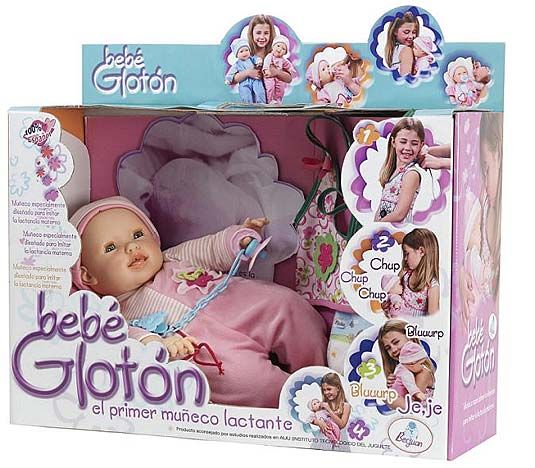
A Spanish company has produced the first breastfeeding doll,
Bebé Glotón, which I understand is supposed to be an affectionate term translating into the rather flat "gluttonous baby" in English.
There's a lot of controversy (natch) about this doll, so I can't even get to the official site above there because the bandwidth has been exceeded. Don't worry, though, you can see it on numerous other websites, filled with comments and commentary that appreciate or lambast (mostly the latter) the dollmakers.
Fox News (of course) finds it in questionable taste to allow young girls to play at breastfeeding. "The halter top has daisies that cover the little girls’ nipples and come undone just as easily as the flaps of a nursing bra would," says the article, which makes it sound smutty indeed. What Fox doesn't seem to understand about how the doll works is that the girl does not remove the halter, or indeed wear it
au naturel; the daisies on the halter are supposed to represent the breasts, and it's when she puts the baby to these flowers that the doll stops crying and starts makes sucking noises. (On the package it's an adorably onomatopoeic "Chup chup chup.")
Fox also has the audacity to suggest that playing at breastfeeding is going to lead to skyrocketing cases of teen pregnancies, because girls will be unable to resist the "maternal urges" to have their own nursling. Well, I'm here to tell you that when my little brother was born when I was 9 years old, I played at nursing my dolls — there wasn't any fancy-dancy noise or motion, and I just lifted my shirt like my mother was doing with my baby bro — and I did not have my first child until I was 31, after having been married for 9 years. So clearly, playing at breastfeeding does not inescapably lead to unwanted teen pregnancy. What it does do is normalize breastfeeding and inspire girls to give it a try for real when they are mature enough to become mothers.
All right, so much for Fox's fair and balanced coverage. How about this
"comedy" post by New Jersey columnist Eric Ruhalter? He scoffs at the idea of showing breastfeeding as natural: "I don't think any mom (pre-teen or otherwise) is contesting the fact that breastfeeding is healthy and natural. I think it's the clogged ducts and the cracked nipples that put them off." Then he echoes the fearmongering that playing at breastfeeding is going to induce unwanted pregnancies. (I'm sorry, but isn't it very young girls who play with dolls? By the time I was nearing puberty, my dolly days were over.) Then he finishes up with suggesting a range of other "what will they think of next!" dolls: "Bebe Sot - The doll who has a problem with a different kind of bottle, and loses his family, job and feelings of self worth? ? Bebe Limp - The male doll who experiences erectile dysfunction? Bebe Cell Mate - A weak unimposing doll that experiences all the indignation and humiliation of life in prison." Yes, let's compare breastfeeding with anal rape, shall we?
This
post at Thingamababy is actually unbiased and informed. Not so all the comments, which are a bit painful to read through. Basically, there are those who think it's admirable in that it does away with the standard baby-bottle accompaniment and promotes breastfeeding, those who think it's unnecessary because any old doll can be pretend-breastfed by simply lifting a shirt (true, and cheaper), those who think that breastfeeding is sexual and so offering a breastfeeding doll with a halter is sexualizing young girls and turning them into tramps (Uhmmm...), and those who think it's just plain weird. Well, ok, I can see the point of all but the sexualizing. I also like that a lactation consultant wrote in to say that the latch should be wider. It really should.
This
Associated Content post brings up another concern that some have had about this doll: Are we excluding boys from playing with it? I don't think so. If a boy is young enough to feel unashamed about playing with dolls in this culture, he's young enough not to understand and/or care about the difference between what mothers can do and what fathers cannot. I mean, I don't want to speak for every boy out there, but my experience watching boys play with dolls has been that (a) they're very young and (b) they don't think too hard about it. Actually, my 2-year-old tends to bring his dolls to
me to breastfeed them, because that's what makes the most sense to him. I suppose if he were old enough to understand the function of the Bebé Glotón and want to play with it, he might either experiment with the halter himself, or bring it to whatever girl is playing the mother! Couldn't that be just fine, too, for boys to play at fathering by handing a crying "baby" to the mother to feed, and then walking and shushing the infant afterward? Works for me.
What's your take on the doll? I can take it or leave it as a doll, but I like it for what it represents. Apparently breastfeeding
is becoming normalized enough that a manufacturer saw a way to make money off of it! All right, I didn't put it very well, but you know what I mean...
This post is a continuation of Hobo Mama's celebration of World Breastfeeding Week: August 1-7, 2009.

*******
If you've been following along, you'll know that
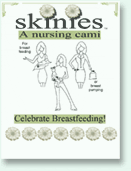
I won a Skinies Open-Cup Nursing Cami a couple months ago and promised to write a review once I'd had a chance to try it out.
Well, dear readers, it's a hit!
I must admit I'm relieved, because if I hadn't liked it, I'd have felt sheepish panning it after getting one for free. I guess that would be one of them ethical dilemmas I hear tell of.
Well, I'm off the hook. I'm here to say, with a clear conscience, that the Skinies cami rocks.
So thank you again to
Skinies, and to
Mommy News & Views Blog, owner of
A Mother's Boutique, for hosting the giveaway.
I had
wondered if there was a good nursing tank for big-busted women, because with my milk-filled bosoms pushing out a 36I (that's
I as in
I can't believe they make bras this big), I don't think the standard shelf bra is going to do it for me. I needed a tank that was compatible with my own supportive nursing bra.
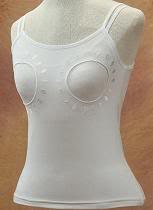
The Skinies is doing it for me. The open-cup design allows you to wear any bra you want to over or under it. If your bra's underneath, reach into the stretchy daisy openings to get to your clasp. If your bra's above the Skinies, then obviously it's no problem to get to it.
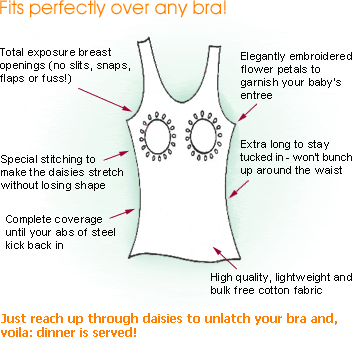
Either way, the circular opening allows the right amount of your breast to get through so that your baby can latch on properly, but it covers up: (a) glowing-white expanse of jiggly breast and (b) glowing-white expanse of jiggly tummy. (NB: Your colors and jiggliness may vary.)
I was actually worried that the cami might be
too supportive in the tummy area, because it touts itself as helping to hold in that postpartum belly. I don't know about you, but I can stand control-top pantyhose for about, oh, 2 seconds, before wanting to rip my legs off. But, as it turns out, the stretchy cami is smoothing without being constricting. I like that the length is long enough to tuck in, too, without riding up, as can otherwise be the case for Spandex-y materials.
So I'll tell you a little of how I put it through its paces for my tests.
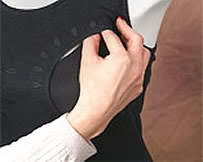
I first wore it with my bra underneath, because that made sense to me and it's how all the pictures show it. I found it a little fiddly reaching in to find my cup latch when I needed to breastfeed Mikko in front of some friends, both unhooking and rehooking. I had breastfed him in front of them a bajillion times before and not felt awkward, so this was a worrying start to my Skinies experience. I'm thinking it might take some practice to get used to wearing your bra under.
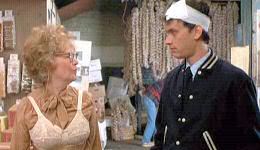
I didn't get that practice, because round about the next time I decided to try the other suggested variation: wearing your bra
over the Skinies. I thought this was a hilarious idea. It reminded me of
Splash
— anyone remember
Splash? And the
woman who comes to work with her bra outside her clothes? Anyone?
It was especially chuckle-inducing, because my bra for the day was black and my Skinies cami was white. Yea for contrast!
As it turns out, though, if you're wearing your clothes right, no one will be able to tell you're wearing a cami underneath your bra. Because — work with me here — if you're wearing your clothes right, no one will be looking at your bra, and the cami will be hidden below it. See? So it seems bizarre, but it actually works.
And I really liked wearing it that way.
First of all, I had easy-peasy access to my nursing bra's hooks. And once my bra cup was down, the Skinies covered the breast that would have otherwise been exposed on top, if I was pulling my shirt down, or my tummy, if I was hiking my shirt up.
So, now for the real tests. My parents-in-law were visiting, and I found myself with several opportunities to wear what would otherwise be inappropriate nursing clothing, in front of my father-in-law, and
not show him any boobage.

Here is a run-down of some of the test items I wore that week: a fitted button-down shirt (usually exposes a whole heaping lot of chest when I nurse), a tight-fitting silky shirt that I have to pull up from the bottom (but isn't stretchy so usually exposes a whole heaping lot of stomach and back), and, yes, to be absolutely daring — a dress. An honest-to-goodness dress. Not a nursing dress. Not a dress with convenient holes. One that I had to yank down to get at the goods.
And the Skinies cami persevered through it all.
I was wearing it every day my in-laws were visiting, until it was more of a Skankies than a Skinies. I think I will have to branch out and
buy another — maybe this time in black, to match that bra! (Hey, Skinies, how about even more colors?)
I will now present my only minor quibbles with the cami, to be comprehensive and fair and show that I'm not being bought off with my awesome win... First of all was what I mentioned already, about finding it fiddly to reach into the holes and grab at the latches on my bra. But problem solved with wearing my bra on the outside. Secondly, I'm cheap and each Skinies cami costs $33. Is it worth it? You and your pocketbook would have to judge that. I think it's priced
fairly; I'll just say again that I'm cheap and that I'm glad I got to try it out for free. I have a load of regular old plain-cotton tanks and camis for layering that cost very little (and are in a wider array of colors), and
I've learned how to nurse in public comfortably without any specialty items. So if I know I'm not going to see anyone I'd fear flashing, I often reach for a regular tank and just go ahead and show a little skin if necessary, reserving my Skinies for times when I know I want to be especially covered, or for when I'm wearing an outfit that I know will be hopelessly indiscreet to nurse in (see my dress story above). My last quibble is that sometimes a low-cut top will slip so that you can see the top of the holes. This is a sartorial issue whether I have my bra on under or over (especially so if it's under and my bra peeping through the holes is a different color!). My usual layering tanks come up higher than my bras so that my shirts don't necessarily have to. Maybe I just buy slutty shirts and this is only my problem. I only point it out to say that sometimes I felt I needed to wear a Skinies
and a tank and then my shirt, but that can get a little too layered, especially in Seattle's recent heat wave.
But I don't want to end on a quibble, so I'll just reiterate that Skinies is very inventive, high quality, and useful for breastfeeding mamas. It transforms any outfit into a nursing outfit by giving you coverage where you need it, but not a bulky shelf bra that won't do you (well, me, at least) any good. It lets you wear your own favorite bras so that you can be literally any cup size and still get the support and coverage you need. I was worried that the holes would dig into my skin if I wore it under my bra, but that wasn't the case; it's very comfortable. It has stretch but is soft and isn't overly synthetic feeling. Overall, it's also slim-fitting, so it doesn't add bulk to your outfits and can be tucked in easily. The holes were cut big enough that no fabric got in the way of Mikko's mouth. Trust me, I would have heard otherwise. You could also pump in this garment with no problem.
The Skinies cami is the brain child of a
breastfeeding advocate and mom of six (and you can
visit Jodie's own blog here). She had the same experience I did: big lactators and no good nursing cami options. Instead of just complaining and speculating, though, she designed her own. Upon further reflection, I think the price can be justified in a couple ways: First of all, you're supporting a small, mama-owned business. Secondly, you could get two or three of these camis (to allow for washing so you don't get yours all smelly like I did mine) and still spend a whole heaping parcel less than if you tried to buy a whole nursing wardrobe. It will also keep your regular wardrobe looking nicer longer, because I know I've stretched the necks out on all my regular tanks!
One more plus in its favor: The literature that comes with it recommends it as a good sexy option, sans bra, to surprise someone special with. Gotta love that!
I think Skinies would really be a blessing for any of you nursing moms who otherwise would feel uncomfortable venturing out to nurse in public, or even at home in front of visitors if you're just getting the hang of nursing a newborn. It would also make a gracious baby shower gift if you know a mother is considering breastfeeding.
So there you have it. I will have to add it to my stockpile of
discreet and easy nursing-in-public options.
Thanks again to
Skinies and
A Mother's Boutique for letting me test-nurse this beauty!
This post is a continuation of Hobo Mama's celebration of World Breastfeeding Week: August 1-7, 2009.*******
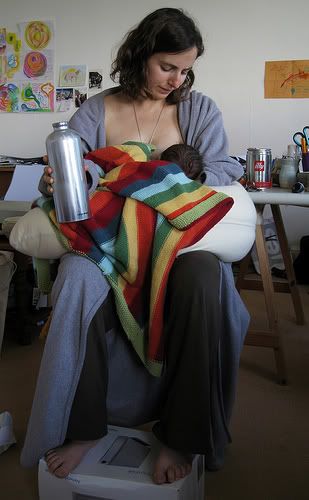
This goes along with my last post about having a topless babymoon.
I realized that going nude when you have guests clamoring to see the newborn might not be possible. And that led me to offer a suggestion for how to arrange those first few weeks after you've had your first baby.
I say first baby, because your childcare needs will presumably be greater with subsequent babies, making early visitors more of a help, since they'll have something to do. Also, you might have already established a good breastfeeding rhythm with your previous baby or babies and not need as much practice the next time around. If you will, though, read on.
I'm not a big believer in due dates, assuming that babies will be born when they're ready, not answering to any email reminder from Yahoo! calendar. But our parents hounded us until we gave in and gave them the all-sacred due date. And then they started searching for airline tickets, because they all live across the country from us.
Hold on just a darn-tootin' sec, we said. (We speak that way for we are country folk.) (Not really.) The earliest you can come is two weeks after the due date, we said.
This was the latest they would consent to come, actually, and so we began hoping and praying that our baby would agree to come near or before his due date, after all. Because if he came two weeks "late" (and I don't think that would actually make him late — see comment about the stupidity of due dates above, or
check out this paper, which has a handy chart showing the normal distribution of births at various weeks gestation), our parents would be on us before he was even out of the birth canal.
Fortunately for us (and yet, annoyingly in that it confirmed our parents' irrational trust in calculations), Mikko arrived just a few days after his due date. (And, yes, those few days were filled with emails and messages: "Is he here yet? Why isn't he here?")
Regardless, we had a solid week and a half for our babymoon.
And very thankful I was for it.
As eager as I was to show off our new kidlet to the grands, it turned out we really needed that time to rest, to recuperate from the birth (physically, I mean, for me, and that was with a relatively easy vaginal birth with little tearing), to get used to having an actual baby around (!!!), and, most importantly, for me to hang out all day with my breasts exposed.
Because, let me tell you, getting started breastfeeding was not a walk in the park like I had been hoping. I wrote about our experience here in
"Finger feeding and baby hickeys," so at least it has a funny name. What it was not, my loves, was an enjoyable time. To sum up, the nurse at the hospital had given us some bad advice about breastfeeding (no! say it ain't so!) and gotten our son hooked on fast-flowing bottles of formula. It took a week of complementary feeding techniques to undo the damage and get him onto exclusive breastfeeding. Once he was, no problemo. But for that first week, Sam and I felt like octopi, or like we wanted to be, trying to coordinate a bottle of expressed breast milk, a feeding tube, flailing infant fists, and engorged post-pregnancy boobs. And in between each feeding, I was attached to a double electric pump to prepare for the next one, and Sam was washing out all the paraphernalia. And then, ten or twenty minutes later, it would all begin again. It was a really bad and complicated start to breastfeeding.
What I appreciated during this experience, though, was that no one was around to see it.
If our parents had been around, particularly my father and father-in-law, I would have felt so very vulnerable to having them see me feed Mikko in such an awkward, exposing manner. I would have had to seclude myself and my son in our bedroom whenever he needed to feed, which was
all.the.time.
I know that some people's family members arrive and are consummately helpful, amusing older siblings, running loads of laundry, cooking meals. Not so our families. Maybe they would have been that helpful if, say, only our mothers had arrived just before or just after the birth. As it was, both grandparents' visits (they were essentially back-to-back) were nonstop vacationing, going from one attraction to another with newborn in tow.
It actually was all right. I was breastfeeding successfully by then, for one, and we had plenty of baby slings and wraps, so Mikko was finally portable. And it gave us a nice change from being holed up with a breast pump, an array of feeding tubes and finger foods that we grabbed at to sustain ourselves whenever we had a spare moment.
But there is no way I could have handled that kind of activity those first couple weeks just after the birth. So my conclusion for anyone wondering whether or not to invite loved ones in immediately surrounding the due date is to ponder what's in it for you. Do you have helpful family and friends? Do you mind being seen topless and unshowered by said visitors? Do you mind having them see your house a mess? Do they mind pitching in? Because the last thing you want to be doing just after giving birth is vaccuming and washing guest towels, honey.
If you haven't had a successful breastfeeding relationship before, definitely think about whether you want observers as you practice and learn. I sometimes wonder whether we'd have stuck with it through all the crazy feeding techniques we tried if we'd had other people peering in. Would we have just given up and gone with formula? I hope not, but I'm glad we had our time free of outside viewing and criticism to experiment and figure things out for ourselves as new parents.
I acknowledge that other people's situations and cultures might make having a family-free postnatal experience an impossibility or an undesirability, and I respect that. I've heard tell of mothers who swoop in for a couple months of behind-the-scenes helpfulness, like an unpaid postpartum doula, but I regard those as legends in the realm of Paul Bunyan. All I can tell you is what worked for us in our reality, with our family, so that in case you fear the worst from relatives visiting too soon after the birth, you hereby have my permission to tell them where to get off.
So, anyway, happy babymoon to you, whatever you decide to do! If you
are going to have unhelpful people pouring in on you just after the birth, I'd recommend laying a few ground rules, and take as much time in private as you need. We made it clear to our parents, when they did come, that we would be sleeping as much as we dang well pleased — and we did. We told them they could make themselves breakfast and have a nice little walk along the beach, and we would see them at noon, because we'd been up at 4 in the morning (and 2, and 6, etc.) with a screaming infant. And, you know, that all worked out OK. They had heard the screaming infant, too, and had to acknowledge that our demands for concessions were fair.
Sometimes you just need to remind people who the parent is around here! Stand up for yourselves,
stand up for your baby, and prioritize your early breastfeeding relationship. You never get another chance to babymoon.
This post is a continuation of Hobo Mama's celebration of World Breastfeeding Week: August 1-7, 2009.
*******
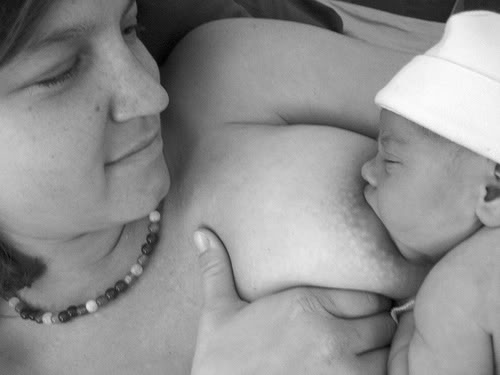
A shirtless weekend of uninterrupted breastfeeding initiation worked wonders for my sister-in-law, and I've heard it works for other mamas, too.
Due to a
rockier start at breastfeeding, I did something similar but more complicated, with feeding tubes and other assorted inanities; I recommend going for exclusive breastfeeding instead of any supplementation and pumping, if you can swing it.
I'll explain how below in a simple, three-step program:
1. Have a baby.
2. Take your shirt off.
3. Carry or wear your baby for at least two days straight, sleeping together whenever the baby sleeps.
You will find that the newborn will gravitate toward your toplessness and do what comes naturally:
breastfeed!
This might sound like I'm oversimplifying matters, but really, what you need most when it's your first time breastfeeding — or when you've had a lack of success before — is practice. And the best way to practice is to let your baby nurse as often as possible.
So close the blinds, rent some good DVDs, and strip from the waist up. Even if you have a winter baby, your snuggling will keep you warm. (All right, you can put an unbuttoned cardigan on if you need to...)
Then just let your baby lead you in how often to feed. If you're just getting the hang of things, go ahead and stop,
sit with a comfy nursing pillow or
lie down side by side, and just nurse. Let your
partner or another (unembarrassed) helper bring you food and plenty of water to drink, and don't give housework or work-work a thought. It's not being lazy to put your feet up in those early days, just as in your pregnancy days — you're still growing a whole baby, after all! If you really want to get something done or just feel restless,
strap your baby to your chest, facing in, and let her snack as she wishes while you wander free.
It might surprise you
just how often a newborn eats, but go with the (milk) flow. In fact, that's how milk is produced in the first place: supply and demand. Your baby's suckling prompts your body to produce more milk. If you try to space out your feedings or limit the time your baby spends eating in hopes of "filling" your breasts, you're shooting yourself in the foot...er, breast...er, ouch, never mind that analogy. Here, read this article from Kellymom:
"How does milk production work?" It even has handy-dandy diagrams showing how milk is made.
Now, it's natural to be worried about milk supply, particularly in a culture where breastfeeding is not the norm and you might not have had a lot of experience seeing it firsthand, a culture in which bottle feeding seems more straightforward and surefire. We're accustomed to see-through bottles, with lines that measure liquids in ounces; there's no seeing through the opaque flesh of your breasts to make sure they're filling with milk, and your baby's not giving you any feedback in numbers as to how much he's eaten in the past 24 hours. The good news is, no matter if you have a normal, low, or high milk supply (and it's probably normal, fyi), the first suggested solution is always the same:
Breastfeed often. As often as
your baby wants to eat, feed him. If you don't want to take just my word for it, read another article from Kellymom:
"Increasing Low Milk Supply" — which has this word of advice:
"To speed milk production and increase overall milk supply, the key is to remove more milk from the breast and to do this frequently."
To remove milk (and thereby ensure that you produce more, until eventually you're at just the right amount for your particular baby), get the baby
latched on and positioned properly, and breastfeed frequently. Your topless babymoon will allow you to do just that!
If you need help improving your latch or you're concerned about discomfort on the part of your baby or yourself, don't be shy about hiring a
lactation consultant, contacting a breastfeeding-friendly midwife or physician, or having a knowledgeable friend or relative visit to help make sure everything's going right. Sometimes it takes just one little tweak from someone experienced and you have an "aha" moment, followed by comfortable, painless breastfeeding forever after. So if you are having difficulties, don't hesitate to call in some support, even if you don't have a shirt on! A
La Leche League leader won't be fazed, believe me.
You might think that two days of being holed up in a cave with no shirt on and no visitors sounds dreary. Try to think of it as cozy instead. (In reality, you'll probably be so spaced-out and feeling so surreal that your baby is here and
in your care that you won't even know how much time is passing!) But if all else fails, think of it as hunkering down and taking a two-day breastfeeding intensive. Your baby is born knowing how to breastfeed, but you have to put in the effort to learn how to meet her halfway. It takes practice, my dear — give it a couple topless days, and see how it goes.

 This post is a continuation of Hobo Mama's celebration of World Breastfeeding Week: August 1-7, 2009. There are affiliate links in this post.
ETA: There is an updated and expanded review of many more nursing pillows at Hobo Mama Reviews from August 2010.
Boppy vs. My Brest Friend?
It's a trick question, because here's the answer: You decide!
If you're pregnant or newly nursing, chances are you've encountered breastfeeding pillows. And if you're wondering what they are, which to get, and whether they're worth it, read on.
The point of any breastfeeding pillow is to make breastfeeding an infant easier. It raises your baby's mouth up to nipple height without your having to bend over or contort yourself, particularly important as you recover physically from the pregnancy and birth. It also gives your baby a firm, comfortable surface to rest on as she or he feeds. It gives your arms a place to rest without strain while you hold your infant's head in the right position, and might even give you a chance to nurse hands-free!
I was fortunate enough to find a
Boppy in pristine condition at a yard sale for $5, and receive a
My Brest Friend
from my nanny sister-in-law as a hand-me-down from one of her families. So I got to try them both out, along with some other methods, and here's my take if you're trying to decide whether to get one or both or go another route.
BOPPY:
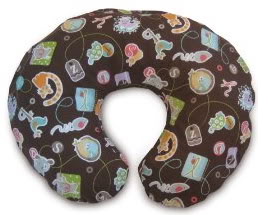
The
Boppy
is the easiest to find, gracing the aisles of baby superstores and discount department stores, along with
its various and ever-spawning incarnations and accompaniments
: slipcovers, satin, organic, gusseted, lounger, play gym, changing pad, shopping cart cover, head support, swing (!), etc. I can't even tell you which type of Boppy to get, just that mine, being from a yard sale, was an original standard version, and the slipcover I registered for and received at a baby shower was a
baby-soft velour
. I'm going to go ahead and recommend the slipcover, just from cuddliness, though one would also come in handy if your baby spits up a lot, because it's easier to clean a pillowcase than a pillow.
Boppies are a little on the expensive side for what they are: a crescent-shaped pillow. But I'd say odds are good that you'll get one for free, and that can't be beat. Whether it's a gift from a baby shower or whether a friend who's done with baby-rearing is cleaning out the closet, you can usually pick one up pretty easily.
The shape of the original Boppy is kind of narrow, which is why they added the gussets — oh, excuse me,
"expandable miracle middle." It still might be too pinchy for plus-sized figures (in which case see some of my alternatives below). I was able to pull mine out to fit me well enough, because it was stretchy enough to pull as wide as I needed. However, it wasn't comfortable to have squeezing my sides for long periods of time, and it usually had to rest on the armrests of chairs rather than fit inside the seat portion. If you've already given birth, you might test drive one before you buy. If you're currently nine months' pregnant, don't bother! It
won't fit. Ha ha! (Yes, I'm speaking from experience. I was nesting and dreaming and wanted to pretend to be nursing, but there was a huuuge baby bump in my way!)
What I like about the Boppy compared to the My Brest Friend (below) is that it's a little more streamlined. Plus, since it is so ubiquitous, you don't feel goofy about hauling it out or dragging it around as needed. Everyone's seen a Boppy, so no one will bat an eye.
The Boppy is curved on top, and the My Brest Friend is straight across. Try to see which you like better. I personally enjoyed that my baby tilted into me on the Boppy because of the slight incline; it set him up in a good latch position.
If you're tall (or high-breasted, I guess is more to the point), the Boppy might not be high enough for you. I found that sitting in a chair with close enough arms (like my favorite nursing glider) and balancing the Boppy across them worked pretty well, though.
One of the touted benefits of the Boppy is that you can later use it for propping your baby up in a sitting position or for a push-up position for tummy time. I never actually got into using it that way, so I won't comment more except to say that you could probably use the My Brest Friend the same way if that floated your boat. So, on to...
MY BREST FRIEND:
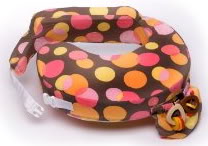
A con for the
My Brest Friend has got to be the embarrassing name, because my friends and I giggle every time we say it. It's almost regulation that you snicker sheepishly after saying it aloud. If you can't figure it out, it's a mishmash of "best friend" and "breast friend." Because it's
both! Get it?!
It's also more expensive than the Boppy and a little harder to find. Don't let that stop you if you're determined and you have a good source of baby-shower gifters.
The differences of the My Brest Friend versus the Boppy, and why some mamas prefer it:
It's entirely flat on top, not curved toward the sides. If you have trouble lining up your baby with the Boppy, it might help to have a more shelf-like surface. Some mothers adore the My Brest Friend for this reason, so give it a try if other pillows aren't working for you. The My Brest Friend is very firm, so the baby won't sink in
or slide around on the surface.
The surface is also a little wider than the Boppy, so there's more room for a big baby (or, perhaps, multiples, though I never tested this idea). That said, I had a huge baby and managed with everything I'm mentioning here.
The My Brest Friend latches all the way around and buckles. I swear the site used to have a video that showed a mom getting up to answer the door with it still buckled around her waist...
like this was a good thing. I can think of little more humiliating than greeting the UPS deliverer with a nursing pillow flopping down over my crotch. "Oh, this old thing? It's My
Brest Friend..." [Cue snickers.]
But...somebody must like that feature, so I mention it here. I guess if you're walking around a lot between short breastfeedings intervals, it might come in handy...no, forget it. I'm not even going to try justifying that benefit. If it appeals to you, please explain.
The fact that it reaches all the way around means it gives a little lumbar support. Only you can decide whether that's helpful or uncomfortable. I found I didn't mind it but didn't really need it. If I sat in a good chair (like a
glider
), I didn't need anything in back. And when I sit in bed, I always pop a couple pillows behind me anyway. But it might be helpful if you need it.
The other nice aspect of the reach-around is that it supports your arms as they work to support your baby's head. And, since this pillow is so firm, you could also do some hands-free nursing as you
read a book
or take a phone call (or write a blog post, if you're feeling particularly ambitious).
The strap is adjustable, so it should fit a wide range of body types. That said, it most likely doesn't fit
everyone, so try before you buy if possible. (And see my additional remarks under the VIVA! pillow below.)
There's also a little pocket in front. I never could figure out what to put there. Chapstick? The remote?
Leak pads? I don't remember exactly how big the pocket was, but I don't think, say, a book would fit. But maybe you'll be inspired. I just looked, and the pictures online suggest a water bottle or a teething ring. Well, there you are.
Truly, the main reason anybody prefers the My Brest Friend over the Boppy is the flat vs. rounded thing. So give them each a try, and see what works for you.
But don't feel bad if you can't afford more than one, or if you can't afford even one, because there are a couple more options:
BED PILLOWS:

Yes, regular old pillows that you have around the house and use every night. Raid your guest stash. I already had for sleeping during pregnancy, with one between my knees, one at my back, one under my belly, and one under my head, so I was set.
I found that two of my bed pillows stacked on my criss-crossed legs when I was sitting in bed substituted nicely for any other specialty pillow. One didn't bring my baby up high enough, but two was just right. It's going to depend on your own pillows' firmness and loft, of course, so experiment. You could also try decorative cushions to see if you prefer something stiffer.
Sometimes mamas will also use additional pillows to prop up their arms like armrests (I did, when sitting in bed — did I mention I had a
lot of pillows?), or a very small pillow or folded cloth to prop up a large breast for ease of lining up with a newborn's mouth. (And there are commercial versions there, as well, such as
Utterly Yours
and
Cushie Pushie.)
If all these pillow options don't suit you, there's always my current favorite:
NOTHING:
When you have a small baby but no access to a pillow, try sitting upright in a chair and crossing one leg over the other. This automatically raises the baby higher and might be just enough. If there's a small stool (or a
nursing stool) nearby, you can lever the crossed leg even higher and tilt your baby into you. This tip worked really well for me when I was out in public nursing a newborn and didn't feel like lugging a pillow along.
As your baby gets older, you'll find that the pillow(s) become unnecessary, anyway, because they soon grow big enough to be settled at the right height, or get themselves to the right height, without boosting.
If you've only ever breastfed with pillows propping you and the baby up and you're terrified of going it solo, just take the first small step into it. Try without a pillow at home in a relaxed setting, and see how it goes. Remember,
the only way to figure out how to breastfeed without a pillow (as with anything) is to practice it that way.
Another good option for breastfeeding without a pillow is to invest in a good sling or wrap carrier. For a newborn, try a
ring sling or
stretchy wrap and face them in so they have easy access.
So those are the options I know about. But I did discover some other nursing pillows online, and here are a few with decent reviews if you want to explore further:

•
Cuddle-U Nursing Pillow And More
from the unfortunately named company Leachco. (I was going to say something even more snide about how it sounds like bad chemicals wafting forth, but
I've since found out that it's named after a couple who committed to offering quality and innovative baby products made in the USA. All right, then, Leachco, you win. Besides, I really like your
bath pillow.) Anyway, the unique part of this pillow that reviewers mention (the "and more" in the name) is that it has a cuddly lap belt that one reviewer says tricks the baby into thinking he's being held. Um...ok. Still, if you have multiple kids or require that no baby be strapped to you at some point (in the shower, operating a chainsaw, etc.), that might come in handy. (Just see how happy the baby in the picture is! He's under the misapprehension that he's being held!)
•
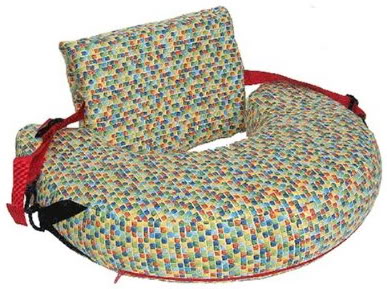
VIVA! Breastfeeding Pillow
. Ok, this one's actually pretty cool looking. First of all, it's
inflatable. So it would be easy to travel with it. I'm imagining you wouldn't want to deflate it on a regular basis, thinking you're going to tuck it in your diaper bag and whip it out wherever you need it. I'm imagining someone in, say, a museum, screaming baby on one shoulder, huffing and puffing on the valve. But, anyway, inflatable's great for longer term storage, such as in a suitcase, or for when you're in a nursing-pillow-using hiatus but want to keep them around for the next nursling. (That's where I'm at.) And inflating means you get to choose how firm or soft it is. Secondly, it has full back support (taller than the My Brest Friend). And the pictures show that it expands to fit anywhere from a 22-inch to 44-inch waist, plus an extender if you need it, so it looks like a good option for plus-size mamas. If you compare the straps to the My Brest Friend, you'll see that the My Brest Friend expands on only one side, meaning the back support goes awry if you're over a certain size. This pillow expands evenly from both sides, keeping the back support centered.
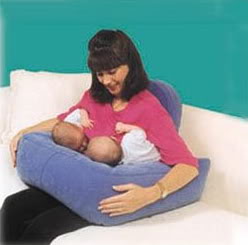
• Here are a few options for nursing twins or larger babies:
Luna Lullaby Bosom Baby Nursing Pillow
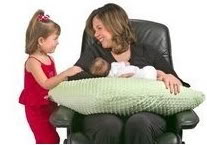
(I don't make up these names, folks) looks bigger than the standard pillows and is more of an L-shaped so maybe fits in chairs better. (The picture is
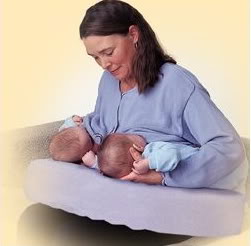
the very first one at the top of the post, with the little girl looking on.) Then, two pillows specifically made for multiples are the aptly named
Double Blessings Twin Nursing Pillow
(lots of pillow to love) and the
Basic Comfort Ultra Plush Nurse EZ Twin Pillow
(this is the picture with the color-coordinated babies
and mother
and pillow).
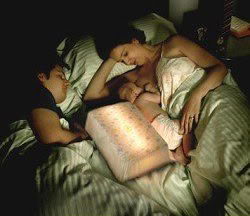
• For cosleeping novelty, there's the
Nurse N Glow Lighted Nursing Pillow
, which looks like you're trying to recapture your
Gloworm
days. But I can understand why having light — but not too much light — can be essential in those early breastfeeding-and-cosleeping days, when you need to make sure everything's lined up right and the baby's not being smothered, but you don't want to (heaven forbid) wake the baby to satisfy your anxieties. A nice LED glow on a timer could be just the ticket, and we'll assume that it's safe. This isn't the type of pillow that you use sitting up — it's specifically for cosleeping, getting you lined up properly to
nurse in a side-lying position (a sanity saver for the breastfeeding mama, because you can get some
sleep finally!), and acting as a safety barrier between your baby and your partner or other bed-sharing children.
A note about safety: All breastfeeding pillows warn not to let baby sleep on them. In fact, the Boppy slipcover I have has a tag sporting a big SLEEP with a line through it, which I found poignantly amusing in those sleep-deprived newborn days. Now, chances are, your nursling's going to fall asleep on a breastfeeding pillow at some point. Ideally, you could then transfer your baby off the pillow and onto your lap or into a sling or into a bassinet or whatever, but, well, if you're anything like me...at some point, your baby will be sleeping on a breastfeeding pillow. My safety warning, then, is not to fall asleep yourself while your baby is sleeping on the pillow. Make sure you're aware of mouth and nose position and any breathing obstruction, and then enjoy the peacefulness. If this happens a lot, I think a My Brest Friend would be the safest pillow for infant napping, because of its flat and firm top, with the Boppy second and bed pillows a distant third, because of their squishiness. If you
are going to fall asleep, transfer both of your sweet selves to an appropriate position in an appropriate bed.
If you have other favorite nursing pillows or experiences with the above, please leave a comment!
Happy pillowing!


 I'm Lauren Wayne, writer and natural parent. I embrace attached parenting with an emphasis toward green living.


