Welcome to the February Carnival of Breastfeeding: Overcoming breastfeeding challenges
This month, we're sharing our stories of overcoming breastfeeding difficulties. Be sure to check out the links at the end for the other participants' excellent posts! I'll be adding more throughout the day Feb. 22.
If you're wanting to breastfeed your baby but need to supplement with expressed breast milk or artificial formula for whatever reason, there are ways to do the supplemental feeding to encourage future breastfeeding success.
If you supplement with bottle feeding, particularly with a very young baby, you run the risk of causing nipple or quick-flow preference in your baby, jeopardizing the possibility of feeding partially or exclusively at the breast.
When Mikko was born, an overzealous nurse wanted to give him a bottle of formula. That one action set up a cascade of consequences, in which Mikko developed a flow preference where he would shriek and refuse to latch if he didn't immediately receive a strong flow of milk and we therefore spent a week doing supplemental feeding with first formula and then pumped breast milk. At the end of that brief but frustrating time, Mikko transitioned to feeding fully on the breast, so here are some techniques that might help you if you're in the same situation. Reasons you might be are because your baby was born premature or with latch problems (perhaps due to a physical deformity of the mouth or tongue or a developmental delay), or because of interference with the baby's breastfeeding instincts, as was the case with us, or if you've adopted an infant and are inducing lactation.
Here are four supplemental feeding methods that don't involve artificial nipples, in order from easiest to hardest, and I'll describe them in detail further down:
syringe feeding
cup or spoon feeding
finger feeding
supplemental syringe at the breast
supplemental tube at the breast
For any of these methods, you could use artificial formula, but it's even better if you can use breast milk, either by pumping your own breast milk or by arranging for a breast milk bank donation if your baby qualifies due to health issues. Pumping while caring for a newborn is, unfortunately, even more exhausting than caring for an exclusively breastfeeding newborn, but it's worth it to keep up your milk supply if you wish to transition over to exclusive (or partial) breastfeeding. All I can say to encourage you on this journey is that it is so much easier to breastfeed, so if you keep at it, you'll find the difficulty level drop off dramatically once your baby has transitioned off supplemental feeding, or is old enough that bottles are an acceptable substitute for the other supplemental methods (usually after about six weeks, but pay attention to your baby's cues — if latching to breastfeed is going badly, hold off longer).
The "best" method, then, is the most difficult, which is supplementing with expressed breast milk while the baby is at the breast, so that she can learn to start suckling and make the connection of sucking at the nipple = warm, yummy food. If you find this method causing too much frustration in either you or your hungry baby, start off with one of the easier methods to calm those first hunger pangs, and then switch to using a tube at the breast when the initial impatience is over.
Syringe Feeding
With syringe feeding, you fill a small, needle-less syringe with milk and press it slowly to squirt it into your baby's mouth as he swallows. You can get a specially shaped syringe with a thin, curved tip. You can use an eyedropper if smaller amounts are needed, such as for a preemie or with colostrum. This is a relatively easy way to get calories into your baby, but one concern is that this doesn't meet any of his sucking needs. You can add in sucking opportunities by slipping a finger alongside the syringe, as in Finger Feeding below and in the picture at left. Particularly if there's no sucking involved, save this one for when you need to stave off those hunger pangs right quick.
Cup or Spoon Feeding
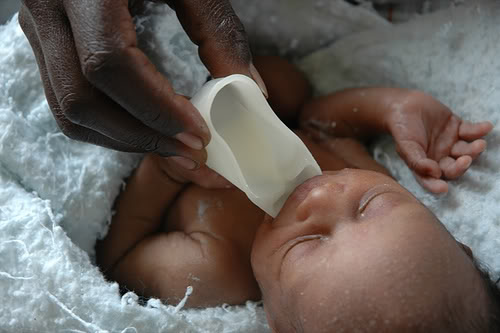
In this type of feeding, you use a small cup or spoon and encourage her to lap up the milk with her tongue at her own pace. Even newborns can theoretically learn to drink from a cup if given a chance. You can use a standard small cup you have around or a specialty item like this flexible feeding cup (similar cup in photo to right) or this wide spoon feeder that can be attached to a bottle (see a similar spoon in the photo at the very top of this post). I've said this type of feeding is a step up in difficulty from syringe feeding because you have to prop your baby up more and persuade your baby to take in the milk; it also tends to be messier, so have a cloth ready under her chin. To me, when we tried the method at a few months of age, it was more to coordinate. However, it's a good way to get a more significant amount of milk into your baby than a typical syringe can hold (unless the syringe is attached to a tube dipped into a bottle), and it is an on-demand type of feeding in that the baby controls the amount of milk she ingests. Similar to syringe feeding, however, this does nothing to satisfy the baby's sucking needs or train her to feed at the breast.
Finger Feeding
In finger feeding, you thread a very thin tube alongside one finger and let the baby suck on both your upturned finger and the tube; the tube is either attached to a syringe or dipped into an open bottle of breastmilk or formula. If your baby can suck, he will suck up the breastmilk himself; if his sucking isn't strong enough, you can depress the syringe yourself. (As mentioned in Syringe Feeding, you could alternatively tuck a syringe alongside your finger but wait for the sucking to know when to depress the syringe.) Dr. Jack Newman describes finger feeding in this link: Finger Feeding. It's a good method in that it lets babies suck, and as Newman mentions, trains them in the technique they'll need at the breast. It does take some coordination, though, and parents can tape the tube securely all the way up their finger and hand if they want less to fidget with. To tempt your baby, get the flow started for him by sucking the liquid to the very tip of the tube. In our experience, once we tasted the difference between formula and breastmilk, we decided to use breastmilk exclusively if possible!
One advantage of these first three types of supplemental feeding methods to point out, and as you can see from the photographs, is that either parent, or another caregiver entirely, can perform the feedings. However, if you want to promote breastfeeding, eventually you'll have to try a method that incorporates the breast, and the sooner the better as far as successfully learning to nurse is concerned.
Syringe Feeding at the Breast
As Dr. Jack Newman says: "Babies learn to breastfeed by breastfeeding. Mothers learn to breastfeed by breastfeeding. The baby continues to get your milk. The baby won't reject the breast. There is more to breastfeeding than the breastmilk." Therefore, if possible, supplement at the breast to get your baby used to feeding there and stimulate your milk supply.
For syring feeding at the breast, latch your baby on, and then dip a corner of the syringe into the corner of his mouth and push when he sucks so that he will be rewarded with any sucking by a whole mouth full of milk. It can help to have a partner for this sort of maneuvering.
Tube Feeding at the Breast
Here's Dr. Newman's handout for using a lactation aid. With this method, you latch the baby on to the breast and then slip a thin tube into the side of her mouth. The tube can be attached to a syringe that you push or dipped into a bottle for the baby to suck under her own steam. Again, you might have to sip on the tube to get the milk to the top so that it will start to flow immediately. This type of feeding is the best supplemental method because it encourages latching, it equates suckling with receiving milk, it stimulates milk production in the breast, and it makes for the easiest transition to full breastfeeding, as sometimes babies will continue to suck even when the tube runs dry. It can be a complicated juggling act, however, so some women prefer to have a partner help out with holding the tube and bottle, or tape the tube between their breasts. There are specialized long-term supplemental nursing systems you can buy that will make this technique more convenient if you foresee supplementing for an extended time (as with a very premature or adopted baby); such systems generally hang on a cord between your breasts and are easier to keep in place. I couldn't find a copyright-free photo to post, but here are a couple links to such a system in use: Nursing with the marvelous SNS from Gabriela Dora on flickr and SNS — feeding tube system at KarenGromada.com. You can see the thin tube stretching into the infant's mouth and read a story of nursing using donor milk at Steph's Story on IBreastfed.com.
A note on financing: Breastfeeding in itself is absolutely free, but using any of these supplemental methods can incur unexpected costs. If your baby is receiving medical care, see what the hospital might have available for you to make things cheaper and easier. We received all our tubes and syringes in a take-home bag from the nurse, and she also helped us arrange a week-long rental of a quality double electric pump for a reasonable price. Again, if you plan to express milk long term (for any of the above reasons or because you plan to return to work outside the home, for instance), you might wish to buy your own electric pump. If cost is an issue, see if your health insurance covers any of the cost, or check with your local WIC office or ask a lactation consultant or La Leche League leader if they know of other avenues.
I hope that gives you some ideas of the options available for non-bottle supplemental feeding for newborns. Obviously, you should consult your pediatrician and an international board-certified lactation consultant (IBCLC) for advice and suggestions specific to your baby. My goal for this article is just to give an idea of the range of alternative feeding methods available that are unlikely to interfere with future breastfeeding success. That way, if a healthcare professional suggests that bottle feeding is the best or only way to supplement a newborn when you desire a future breastfeeding relationship, you can offer an alternate feeding method and find a lactation consultant to back you up. I wish you and your baby all the best, no matter what you decide or what the outcome.
To round off my own experience, the good news is that we cycled through all of these methods and came out the other side — exclusively breastfeeding. And our breastfeeding relationship is still going strong! It was worth all the inconvenience and heartache of trying these alternative methods, knowing it was keeping our goal of successfully feeding at the breast alive. Once we transitioned into full breastfeeding, I was astonished at how easy it was!
External webpage links that are helpful:
Here's an overview of the variety of non-bottle supplemental feeding options from Ask Dr. Sears: Alternatives to Bottles
Here's a link to a PDF handout from Lactation Education Resources on all sorts of nursing problems, including ones that require these supplemental feeding methods: Alternative Feeding Methods for Breastfed Babies. (The helpful drawings illustrating this post were originally on the latter site; if anyone has a better copyright citation, let me know.)
If you feel comfortable sharing, feel free to tell of your own experiences with supplemental feeding and what worked best for you. I was trying to remember some stories that are already out there, and these came to mind. To read of a negative experience with supplemental feeding that eventually turned to the positive, I found this account of "Nipple Intervention," by Whozat, particularly moving. Here's Amber Strocel's account of bottle feeding a premature baby and struggling to transition to breastfeeding but making it with the proper support and equipment. If you have a blog post chronicling your experiences with supplemental feeding, feel free to leave the link for us.
Enjoy these posts from our other carnival participants:
Our first two Carnivals of Natural Parenting were filled with astounding writers and inspiring parenting stories, so we hope you'll join us for the third carnival in March! (Check out the January and February carnivals if you missed them.) Your co-hosts are Dionna at Code Name: Mama and Lauren at Hobo Mama.
Here are the submission details for March 2010:
Theme: Vintage Green: What sorts of “green” things did you do as a kid (even if you didn’t know at the time they were eco-friendly) that you now do with your own kids? Alternatively, what "green" practices do your kids find normal (because they've grown up with them) that you did not do as a child?
Deadline: Tuesday, March 2. Fill out the webform (at the link or at the bottom) and email your submission to us by 11:59 p.m. Pacific time: codenamemama {at} gmail.com and mail {at} HoboMama.com
Carnival date: Tuesday, March 9. Before you post, we will send you an email with a little blurb in html to paste into your submission that will introduce the carnival. You will publish your post on March 9 and email us the link if you haven't done so already. Once everyone's posts are published on March 9 by noon, we will send out a finalized list of all the participants' links, to generate lots of link love for your site! We'll include full instructions in the email we send before the posting date.
Please submit your details into our web form: This will help us as we compile the links list. Please enter your information on the form embedded at the end of this post, or click here to enter it on a separate page: March Carnival of Natural Parenting participant form
Please do: Write well. Write on topic. Write a brand new post for the carnival. As always, our carnival themes aren't meant to be exclusionary. If your experience doesn't perfectly mesh with the carnival theme, please lend your own perspective. Please also feel free to be creative within the gentle confines of the carnival structure. If you're feeling so inspired, you could write a poem, a photo essay, a scholarly article, or a book review instead of a regular blog post (though those are welcomed, too!), as long as what you write is respectful of the carnival's intent. If you want help determining that ahead of time, please talk with us.
Please don't: Use profanity of the sort that might be offensive to more sensitive readers or their children. Submit irrelevant or argumentative pieces contrary to the principles of natural parenting. You don't have to agree with all our ideals — and certainly you don't have to live up to them all perfectly! — but your submission does have to fit the theme and values of the carnival.
Editors' rights: We reserve the right to edit your piece or suggest edits to you. We reserve the right to courteously reject any submissions that are inappropriate for the carnival. Please also note that since there are two co-hosts on different schedules and conferring over email, our personal response to your submission might seem delayed. Don't be alarmed. We also reserve the right to impose consequences if the responsibilities of the carnival are not fulfilled by the participants.
If you don't have a blog: Contact one of us (codenamemama {at} gmail.com and mail {at} HoboMama.com) about potentially finding you a host blog to guest post. Please write your piece well in advance of the deadline in that case, so we can match you up with someone suitable. But if you really have something amazing to write — why not start your own blog? If you want advice, we find Scribbit's free Blogging in Pink ebook to be a very helpful and down-to-earth guide, for beginners on up.
If you have questions: Please leave a comment or contact us: codenamemama {at} gmail.com and mail {at} HoboMama.com
If you are a (former or current) participant or supporter and want our delightful button to put in your sidebar, grab this code and proclaim to the blogosphere that you are a natural parent!
<!-- begin button -->
<center><a href="http://codenamemama.com/carnival-of-natural-parenting/" target="_blank" title="Carnival of Natural Parenting"><img alt="Carnival of Natural Parenting -- Hobo Mama and Code Name: Mama" src="http://i233.photobucket.com/albums/ee159/lintpicker/CNPnaturalparent.jpg" /></a></center>
<!-- end button -->
He's angelic when he's a sleeping sicko and very, very grumpy when awake.
Mikko's been sick (poor guy), so I've been sitting around (watching Olympics, clearly) and listening to him mope and snooze and wake up flailing and cranky and then snooze some more. He seems to have some sort of virus that gives him a low-grade fever, runny nose, and terrible mood.
My lap and my arms have been constantly occupied, so not much else is getting done. At least a friend gave us her old Tivo, so I have lots of TV to keep up with! I think it's always inspiring to watch great athletes while sitting on a couch, snacking on Pirate's Booty. Makes me feel like a hero.
So I'm trying to catch up with several things at once while Mikko naps on my lap. I have both hands to type, but my laptop is rather precariously balanced, so we'll see how far I get.
First of all, a reminder that you can enter to win a copy of Andi Silverman's Mama Knows Breast at Hobo Mama Reviews. If you're just starting out breastfeeding, it will guide you through what to expect. If you're a breastfeeding world champion, win it to give to a friend. I have this idea that every baby gift we give should be something that inspires the recipient toward natural parenting. Good idea? I think so.
You can enter by just telling me something from the MamaKnowsBreast.com blog. Super easy. If you're already reading Andi's blog, just give me a sentence of something you remember, and if it's new to you, take a gander. She's got great breastfeeding news and information there.
You can get bonus entries for following her or me, so if you're already doing that, just leave a comment and you're in it to win it.
Golly, this is uncomfortable. Now I'm kind of tilted to the side, one leg is falling asleep, and my back is angry with me.
Get better soon, Mikko, because (a) I love you and (b) I want my lap back for whole moments at a time.
A word about my submission, the checklist for new parents: I'm so glad the comments were positive, because I was afraid it was coming across as bossy. Well, maybe it was bossy, but everyone can handle a little of that?
A note to Taryn who commented so lengthily (ha! I've gone over the word limit myself so many times!), I have no way to email you from your profile and I wanted to see if you would like to guest post on the subject of preparing for the birth itself. Otherwise, I'll probably just crib your notes. :) I didn't even attempt to include that topic since it's so huge, so I was impressed you fit it all in, despite Blogger's attempts to thwart you.
I need a massage. At least I haven't dropped my computer yet.
You know how I recommended those airport/airplane books at the end of this post on Mikko's current favorite books but I hadn't read them yet? Well, we got them out of the library and — phew! — they're really good. They're fun to read and comprehensive in preparing a little one for an airplane ride, including elements like taking shoes off to go through security, waiting to board, buckling up, using the loud toilet in the lavatory, hearing the wheels kerchunk, seeing the world so tiny below, etc.
Although — I was reading them to Mikko this morning and Sam started whispering to him, "Fight the man, Mikko!" We usually follow more of an unschooling or continuum curve in our approach to situations, but this is one experience where I feel like a lot of preparation is necessary to head off meltdowns and being kicked off planes. Did you hear about Kevin Smith, for instance? Gah. Not that you can prepare for that sort of incident, but my general impression is that flight attendants are getting ever more quick to push the eject button.
So I'm reading these books and really teaching Mikko about how we behave properly in an airport and on the plane, and Sam's trying to undermine my efforts (not really — he was just being a goof, but he had a valid point). What do you think? Is being overtly didactic necessary to prepare a toddler for today's highly charged airplane environment, or should I chill out and let Mikko observe the airplane experience as it comes at him?
Just to be very clear, here are reasons people have been kicked off planes recently:
And a bonus question for the airlines: Are we still paying customers, or are we dependent on your capricious good graces? I somehow thought we were customers.
Leg cramping up. Must shift positions. Should really decrease liquid intake, considering I have no prayer of standing up anytime soon.
Finally, my noodle story.
I like going to this teriyaki place near Mikko's preschool. Sometimes we end up there together, and sometimes I'm alone after having dropped him off. It's a good place to bring him when I need to get him out of the house, because there's cheap and kid-friendly shopping nearby and he'll eat all the broccoli on the plate, a couple pieces of chicken, and some yakisoba noodles and rice. That's seriously a huge meal for him, and it all seems pretty high quality to me.
Granted, he picks out the stupidest bottled drinks from the cooler. His current favorite, chosen after having seen another kid temptingly drinking one near him, is a syrupy-sweet strawberry milk he named "pink drink." He drinks at most a couple sips, and then I'm stuck with it for the rest of the meal. It's like swigging treacle.
So I had this grand scheme for the week, taking him to a different amusement each day to keep him out of Sam's hair while Sam was shrink-wrapping DVDs, but then Mikko fell sick and all our plans devolved into sitting around and wallowing. Yesterday, though, I was beyond stir crazy, so we ventured a modest outing: yakisoba and two short errands.
The lady who runs the teriyaki place is animated and gregarious. She always remembers us, and she chats Mikko up. I like her enthusiasm and cheerfulness.
But...yesterday Mikko was not feeling so hot. He was really zoned and out of it, and he occasionally would cough or sneeze and make me feel like a bad person for having a sicky out to infect the public. He didn't interact with the owner this time, and he ate woodenly (but at least he ate). Until — he choked on a bite of broccoli. It wasn't a big deal, at all. It wasn't a big piece that went down the wrong way; I think in fact it was a tiny floret tip that maybe rattled in his windpipe a little and startled him. He began screaming. And then he asked for what he always asks for when he needs comforting: nummies.
Well, of course. So I picked him up on my lap and he settled in for what I hoped was a quick breastfeed.
I've talked about this before, how I do breastfeed my toddler in public but worry about it nonetheless, but he needed it, on an emotional level, so I wasn't going to refuse. But the restaurant was more crowded than usual. I'd inadvertently stumbled onto the dinner crowd, whereas often there are only a couple tables occupied. I was aware of his breastfeeding, and the sleepy way he was drawing it out. I was aware of a solo woman at the table nearest me asking for a to-go bag and wondering in a paranoid fashion if she was hightailing it because of me. I was aware of Mikko's runny nose and wondering if he was still contagious and if I'd really done an unethical thing by bringing him outside at all.
And then the owner came over, and I hoped — hoped — she just wouldn't say anything. That she wouldn't notice, would pass on by, would get back to work behind the counter.
But of course she noticed, and of course she had to say something. "He's so big!" she exclaimed, laughing loudly. "He's still doing that?" She pointed us out to the woman who was leaving. "I can't get over this!" she yelled to the departing customer. "He's so big!"
Mikko was momentarily distracted, and I detached him and sat him back in his seat, urging him to eat some rice while I surreptitiously did up my bra straps.
I kept my face down and shoveled noodles in and hoped that was the end of it, that we could just finish eating and go home and hide.
But she came back. "Which milk do you like better?" she asked, pointing first to the sugary strawberry monstrosity and then to my chest. "Which milk? This one, right?" she said, gesturing toward the strawberry. She kept smiling broadly and laughing, and I smiled back, weakly but politely.
Mikko looked at her blankly, unsure what she wanted of him. He pushed his plate away and bravely attempted a response. "This one," he parroted, without pointing.
Silly woman, as if anyone could prefer that nasty "pink drink" to subtly sweet breastmilk. As if any toddler, when gagging and sick and sad and overwhelmed, would prefer a cold bottle from the refrigerated case over snuggling with his mama.
And, keep in mind, this is the same person who mocked Mikko for choosing pink milk the first time he did it, telling him a boy should want the brown chocolate milk instead. As if she can impart gender shame to a 2-yesr-old! She didn't succeed, and that incident just kind of rolled off my back as a funny anecdote I'd Tweet about later. But the making fun of my (full-term) (extended) breastfeeding (a toddler)? (Dang it, people, I need a term to talk about this!) There she hit a nerve.
I just wanted to leave. I know she didn't outright chastise me or kick me out of her restaurant or anything horrible, but I'm so embarrassed now to go back there. What would you do? What should I have done at the time? I'd love your opinions to inform my hindsight. Sigh.
Sam brought food home. Going to try to eat some General Chicken without spilling it all down Mikko. Wish me luck, and thanks for listening to my post from the sickbed!
Strawberry milk photo courtesy aschaeffer on stock.xchng. I could unfortunately not find something to convey the full horror of our drink.
See, it's hard to find German-English books on the cheap when you live in the US (or, I imagine, other non-German-speaking countries), and the library has only a small selection available in each age range. If the minority language in your house is, say, Spanish when you live in the US or French when you live in Canada, it will likely be easy to round up quite a few options for bilingual reading time. But if you're stuck with a less trendy second language for your region — and you don't have unlimited book-buying funds — you have to make do.
The way I've done it with my baby and now toddler is by finding English books that are simple enough for me, a non-native German speaker, to translate into German on the fly. He doesn't know that I'm not reading what's on the page, and I have a fun way to insert the minority language into our reading time.
Now, sure, this technique works only on beginners in the target language, and it doesn't reinforce visual reading skills. Plus, it's fun to read actual German children's books to Mikko. So I'm compiling tips for a future post about how you can gather some bilingual books on a budget.
But for now, I thought I'd do a little round-up of books that meet my criteria for switcheroo bilingual reading:
They should be readily available to you in a typical English-speaking country, at the bookstore as well as at the library. They might be on your very own bookshelf at this moment!
They should be entertaining to your young'un (baby to preschool age, or theoretically a beginning learner who's older).
And they should be uncomplicated enough in grammar and vocabulary that even we non-native speakers can translate as we go.
If you aren't strong in the minority language, you can review the books beforehand and visit an online bilingual dictionary. If you wanted, you could even scribble your translations into the margins, or cover up the English words entirely with your own labels.
These tips can also work for parents using baby sign language with their infants or toddlers (or using American Sign Language as a minority language), because it's equally hard to find sign-language storybooks for kids. I've seen a few out there, but it's not something you come across at every corner. These books below are simple enough for even novice signers (like me!) to throw in what they know, same as non-native bilingual speakers (like me!).
Ready?
I mentioned this one in my other article, but it bears repeating. I Love You Through And Through, by Bernadette Rosetti-Shustak, is a simple board book with charming illustrations by Caroline Jayne Church and a lovely message: that you love every side of your child: silly side, mad side, top side, bottom side, giggles and cries, hair and toes. That should give you an idea of the kind of vocabulary you need at your disposal to render the words into your target language. Getting the grammar to scan in your language might require a little maneuvering, but since each page has only a few words, it's easy enough to work around.
Sarah from Alphabet Garten was kind enough to send me (and other lucky duckies) this version of Hänsel & Gretel (yes, in actual German) from her online German children's bookshop as a limited-time incentive for signing up for the Alphabet Garten forums. A belated thank-you to Sarah! Mikko loves it, because it's got flaps! Flaps galore, on every page. Little hidden creatures and secrets that send him on a treasure hunt every time we read. You might not luck into free flap books in your target language, but it got me thinking about other action-type books we have on hand that could easily be translated. Toddlers and preschoolers love lifting flaps, sliding tabs, being surprised by pop-ups, or touching textures. Fortunately, these types of books are not only popular, they're often sparsely worded. Perfect for our purposes! A few we have in current rotation include Dear Zoo: A Lift-the-Flap Book, by Rod Campbell (good animal vocabulary); Touch and Feel: Farm (or other Touch and Feel books in the series; same with the animal vocab); Where's Spot? by Eric Hill (ok, we actually have this one in German! But since the German version is easy, I imagine the English version is simple as well. It also has animal vocabulary, but combines it with locations and prepositions, such as "under the rug" or "behind the door"); Where Is Baby's Belly Button? by Karen Katz (body parts, prepositions, and household terms; e.g., "Where is baby's mouth? Behind the cup!")
An innovative type of activity book I came across at the consignment shop was the books Dress Little Bunny and Play with Little Bunny, by Harriet Ziefert. (Used copies are up at Amazon for the astonishing deal of one cent (plus shipping), so you really can't go wrong.) They are listed as "sticker books," but they're actually board books with static-cling vinyl film stickers, so they're all reusable (and rechargeable, by rubbing them against your clothing!). The pages show little bunny getting ready for some adventure and needing certain articles of clothing to complete her outfit, such as an umbrella and boots to walk in the rain. It gives practice with clothing vocabulary as well as coordination and logic practice for little ones.
There's a lot in the way of animal vocabulary at our house, but Mikko seems to love it. Another is a very cute children's book without much in the way of dialogue: Good Night, Gorilla, by Peggy Rathmann. All you need to know is how to say "good night" and then the names of an assortment of zoo animals. (If you're not a native speaker, you might need help with the likes of hyena and armadillo.) In English or in your target language, however, there's plenty more scope for conversation. Little eyes love to pick out the details on each page, like the mouse with a banana who follows the crafty gorilla, and you can describe the action taking place in the pictures.
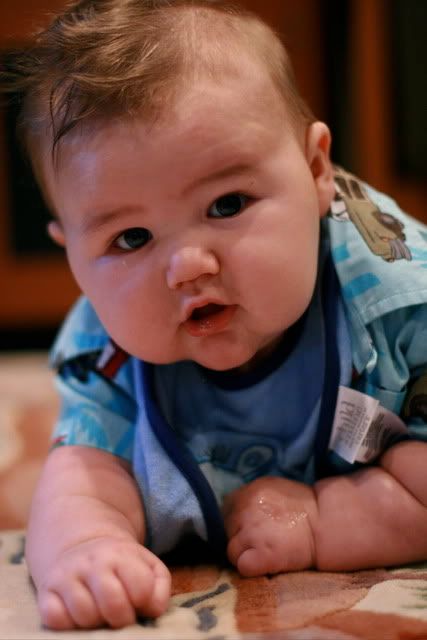
Mikko reading Blue Hat, Green Hat to himself at 15 weeks old. The kid's a genius. Or propped up by his blubber. One or the other.
funny and easy book of hers to translate. Some of her other books have complex rhymes, but this one is just a series of colors paired with clothing (e.g., "blue pants, red pants, yellow pants," followed on each page by "Oops" when the silly turkey gets the basic art of dressing oneself wrong). You might have to research how to say "oops" in your target language (I went with "Ups!" to make things easy on me), but this is good practice for colors, clothes, and learning how to correctly pair adjectives with nouns. In German, as in many languages, the gender of the noun determines how the adjective ending is formed, so it's good reinforcement for both Mikko and me alike. Mikko likes to direct the action when reading this book by pointing to each picture in turn. I have to stay on my toes to say the correct word pairing for whichever one he points to next! You can also expand the conversation to include the animal vocabulary: elephant, moose, bear, and turkey, as well as the swimming situation that comes as a surprise at the end. (Oh, no, I just ruined it! Oops!)
I've loved Big Dog...Little Dog, by P.D. Eastman, since I was a little puppy myself. I must admit, though, I cheat more with this one when I'm reading it in German. It works out, though, since Mikko's still very impatient with flipping pages, so I have to scale back the text in any case to match his pace. What's nice about Big Dog...Little Dog, as you might be able to guess from the title, is that it gives you lots of opportunity to practice opposites: big and little, fast and slow, red and green, wet and dry. Plus, who doesn't love a good story of opposites who make good friends?
If you know a lot of food vocabulary, try The Very Hungry Caterpillar, by Eric Carle. If you don't mind more farmyard vocab, Family Farm (Ana's Animals), by Ana Larrañaga, has super-cute drawings and is currently up for grabs at 10 cents for a used copy at Amazon! And if you want to cover emotions, try a book like Baby Faces, a varied series of close-up expressions by Margaret Miller.
If your minority language is uncommon in your country and you've been able to find any books at all in that language at the local bookstore, I'm going to take a wild guess and say — you have some picture dictionaries! That's all I can reliably find in German at bookstores locally. They're fine and all, but sometimes you want a storybook, don't you? Sigh. Still, might as well make use of them! For our purposes, they can be in English or your target language. A few English-language ones that have worked well for us are My First Look at Numbers and other similar books (numbers, sizes, shapes, colors, etc.); First 100 Words, by Roger Priddy; and Richard Scarry's Best Word Book Ever, which includes lots of traffic-related vocabulary and which I reviewed in my post on "Reading snazzy jazzy books to baby." I had this insight to say about picture dictionaries and word books such as these:
I have mixed feelings toward word books, without story to connect the vocabulary. I say mixed, because before having an actual child with whom to interact with them, I used to find them quite boring as a reader, but now I see how much delight Mikko takes in them. In fact, his favorite book for some time was First 100 Words, presumably because he could sign almost every one of those words. It was such a treat for him to point to a picture of say, a monkey, then sign it (scratch your armpits) and make an "eee, eee, eee" sound (that's what a monkey sounds like, natch), then wait for me to repeat it back to him and say "monkey" out loud several times to show I understood. ... Mikko goes ga-ga over the pages with trains, a recent obsession. He'll start saying "choo choo" and making the train sign (rubbing two fingers from each hand together) while I feverishly and obediently flip pages. Once I find the right one: "Train! Choo choo!" His joy is worth every hour spent poring over word books.
So there you have it. Despite all my sighing over picture dictionaries, they might just be the gateway to bilingual heaven for your baby.
An easy book to make with materials on hand is a photo book of relatives. I've made a few of these for Mikko, using extra brag-book type photo albums I had around the house and prints I ordered online for the purpose. Since we live an extended distance away from our appropriately termed extended family, I wanted to make sure Mikko had a ready set of reminders of faces and names. This is super easy to translate, because all you have to know is the vocabulary of familial relations, such as grandmother, uncle, and cousin.
Another good topic for a homemade photo flip book is daily activities, showing your child going through the routine tasks of the day. You might make a special effort to photograph each step, such as getting dressed, brushing teeth, going to a playdate, eating lunch, etc., and then placing the prints in order, or maybe arranged by days. That would be a good way to go over daily vocabulary in your target language (or, again, in baby sign language) and also emphasize your routines, which many young kids find comforting.
I hope that helps give you some ideas for easy, cheat-cheat-never-beat bilingual reading. Look around your shelves or your library for other simple books that will work in the same way, and let me know if you come across other good options!
I'm Lauren Wayne, writer and natural parent. I embrace attached parenting with an emphasis toward green living.
Riding the rails with my husband, Crackerdog Sam, and our hobo kids, Mikko Lint Picker (born June 2007), Alrik Irontrousers (born May 2011), and Karsten (born October 2014). Trying every day to parent intentionally and with grace.

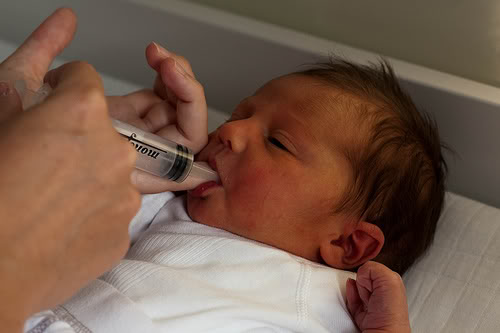 a thin, curved tip. You can use an eyedropper if smaller amounts are needed, such as for a preemie or with colostrum. This is a relatively easy way to get calories into your baby, but one concern is that this doesn't meet any of his sucking needs. You can add in sucking opportunities by slipping a finger alongside the syringe, as in Finger Feeding below and in the picture at left. Particularly if there's no sucking involved, save this one for when you need to stave off those hunger pangs right quick.
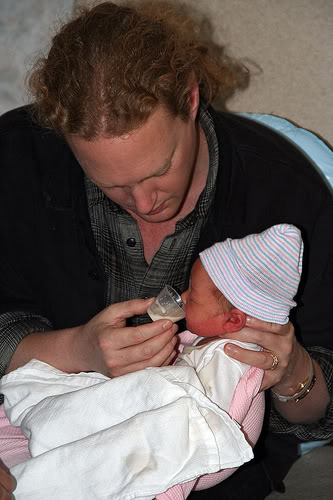 chance. You can use a standard small cup you have around or a specialty item like this flexible feeding cup
 (similar cup in photo to right) or this wide spoon feeder
 that can be attached to a bottle (see a similar spoon in the photo at the very top of this post). I've said this type of feeding is a step up in difficulty from syringe feeding because you have to prop your baby up more and persuade your baby to take in the milk; it also tends to be messier, so have a cloth ready under her chin. To me, when we tried the method at a few months of age, it was more to coordinate. However, it's a good way to get a more significant amount of milk into your baby than a typical syringe can hold (unless the syringe is attached to a tube dipped into a bottle), and it is an on-demand type of feeding in that the baby controls the amount of milk she ingests. Similar to syringe feeding, however, this does nothing to satisfy the baby's sucking needs or train her to feed at the breast.
 In finger feeding, you thread a very thin tube alongside one finger and let the baby suck on both your upturned finger and the tube; the tube is either attached to a syringe or dipped into an open bottle of breastmilk or formula. If your baby can suck, he will suck up the breastmilk himself; if his sucking isn't strong enough, you can depress the syringe yourself. (As mentioned in Syringe Feeding, you could alternatively tuck a syringe alongside your finger but wait for the sucking to know when to depress the syringe.) Dr. Jack Newman describes finger feeding in this link: Finger Feeding. It's a good method in that it lets babies suck, and as Newman mentions, trains them
 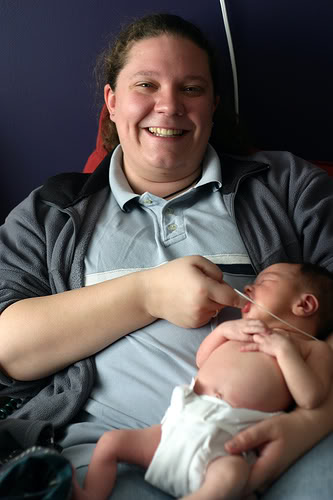 in the technique they'll need at the breast. It does take some coordination, though, and parents can tape the tube securely all the way up their finger and hand if they want less to fidget with. To tempt your baby, get the flow started for him by sucking the liquid to the very tip of the tube. In our experience, once we tasted the difference between formula and breastmilk, we decided to use breastmilk exclusively if possible!
 Here's Dr. Newman's handout for using a lactation aid. With this method, you latch the baby on to the breast and then slip a thin tube into the side of her mouth. The tube can be attached to a syringe that you push or dipped into a bottle for the baby to suck under her own steam. Again, you might have to sip on the tube to get the milk to the top so that it will start to flow immediately. This type of feeding is the best supplemental method because it encourages latching, it equates suckling with receiving milk, it stimulates milk production in the breast, and it makes for the easiest transition to full breastfeeding, as sometimes babies will continue to suck even when the tube runs dry. It can be a complicated juggling act, however, so some women prefer to have a partner help out with holding the tube and bottle, or tape the tube between their breasts. There are specialized long-term supplemental nursing systems
 you can buy that will make this technique more convenient if you foresee supplementing for an extended time (as with a very premature or adopted baby); such systems generally hang on a cord between your breasts and are easier to keep in place. I couldn't find a copyright-free photo to post, but here are a couple links to such a system in use: Nursing with the marvelous SNS from Gabriela Dora on flickr and SNS — feeding tube system at KarenGromada.com. You can see the thin tube stretching into the infant's mouth and read a story of nursing using donor milk at Steph's Story on IBreastfed.com.
 I hope that gives you some ideas of the options available for non-bottle supplemental feeding for newborns. Obviously, you should consult your pediatrician and an international board-certified lactation consultant (IBCLC) for advice and suggestions specific to your baby. My goal for this article is just to give an idea of the range of alternative feeding methods available that are unlikely to interfere with future breastfeeding success. That way, if a healthcare professional suggests that bottle feeding is the best or only way to supplement a newborn when you desire a future breastfeeding relationship, you can offer an alternate feeding method and find a lactation consultant to back you up. I wish you and your baby all the best, no matter what you decide or what the outcome.




 First of all, a reminder that you can

 You know how I recommended those airport/airplane books at the end of
 So I'm reading these books and really teaching Mikko about how we behave properly in an airport and on the plane, and Sam's trying to undermine my efforts (not really — he was just being a goof, but he had a valid point). What do you think? Is being overtly didactic necessary to prepare a toddler for today's highly charged airplane environment, or should I chill out and let Mikko observe the airplane experience as it comes at him?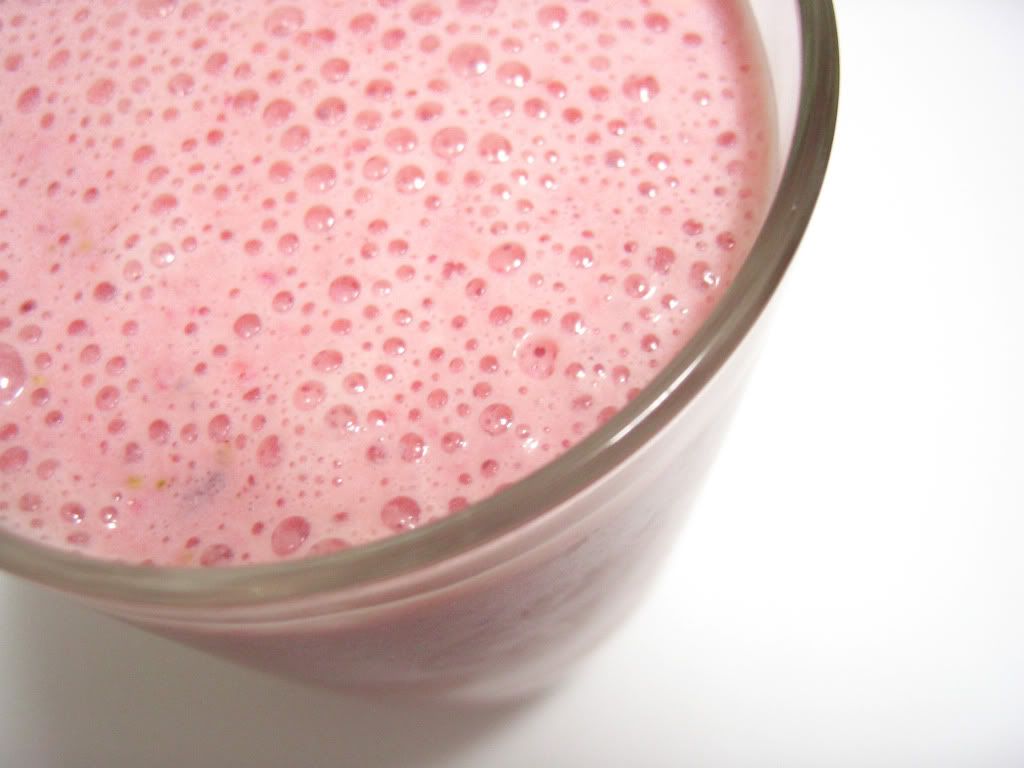



 by Bernadette Rosetti-Shustak, is a simple board book with charming illustrations by Caroline Jayne Church and a lovely message: that you love every side of your child: silly side, mad side, top side, bottom side, giggles and cries, hair and toes. That should give you an idea of the kind of vocabulary you need at your disposal to render the words into your target language. Getting the grammar to scan in your language might require a little maneuvering, but since each page has only a few words, it's easy enough to work around.
 in your target language, but it got me thinking about other action-type books we have on hand that could easily be translated. Toddlers and preschoolers love lifting flaps, sliding tabs, being surprised by pop-ups, or touching textures. Fortunately, these types of books are not only popular, they're often sparsely worded. Perfect for our purposes!
 by Rod Campbell (good animal vocabulary);
  (or other Touch and Feel books in the series; same with the animal vocab);
  by Eric Hill (ok, we actually have this one in German! But since the German version is easy, I imagine the English version is simple as well. It also has animal vocabulary, but combines it with locations and prepositions, such as "under the rug" or "behind the door");
  by Karen Katz (body parts, prepositions, and household terms; e.g., "Where is baby's mouth? Behind the cup!")
 An innovative type of activity book I came across at the consignment shop was the books
  and
and  , by Harriet Ziefert. (Used copies are up at Amazon for the astonishing deal of
 by Peggy Rathmann. All you need to know is how to say "good night" and then the names of an assortment of zoo animals. (If you're not a native speaker, you might need help with the likes of hyena and armadillo.) In English or in your target language, however, there's plenty more scope for conversation. Little eyes love to pick out the details on each page, like the mouse with a banana who follows the crafty gorilla, and you can describe the action taking place in the pictures.
 is an example of a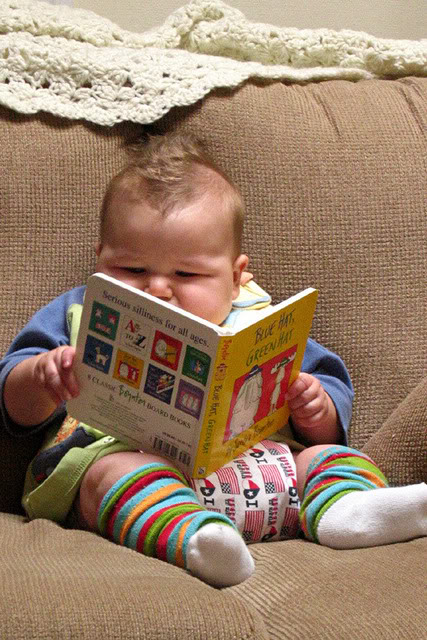
 translate. Some of her other books have complex rhymes, but this one is just a series of colors paired with clothing (e.g., "blue pants, red pants, yellow pants," followed on each page by "Oops" when the silly turkey gets the basic art of dressing oneself wrong). You might have to research how to say "oops" in your target language (I went with
 by P.D. Eastman,
  since I was a little puppy myself. I must admit, though, I cheat more with this one when I'm reading it in German. It works out, though, since Mikko's still very impatient with flipping pages, so I have to scale back the text in any case to match his pace. What's nice about Big Dog...Little Dog, as you might be able to guess from the title, is that it gives you lots of opportunity to practice opposites: big and little, fast and slow, red and green, wet and dry. Plus, who doesn't love a good story of opposites who make good friends?
 If you know a lot of food vocabulary, try
  by Eric Carle. If you don't mind more farmyard vocab,
  by Ana Larrañaga,
 has super-cute drawings and is currently up for grabs at 10 cents for
  ! And if you want to cover emotions, try a book like
  a varied series of close-up expressions by Margaret Miller.
 locally. They're fine and all, but sometimes you want a storybook, don't you? Sigh. Still, might as well make use of them! For our purposes, they can be in English or your target language. A few English-language ones that have worked well for us are
  and other similar books (numbers, sizes, shapes, colors, etc.);
  by Roger Priddy; and
  which includes lots of traffic-related vocabulary and which I reviewed in my post on "


 I'm Lauren Wayne, writer and natural parent. I embrace attached parenting with an emphasis toward green living.


