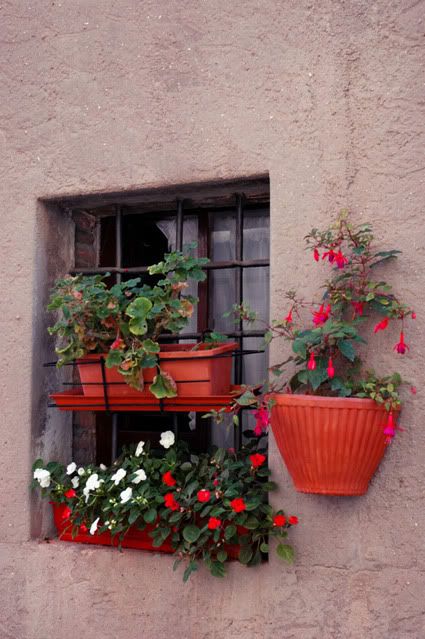
We are moving, and we are losing our outdoor space as a consequence.
I've had to grieve through this, which has somewhat surprised me. We've chosen well in terms of the unit we're moving to, and frankly we just can't afford to own land plus decent interior square footage in our chosen neighborhood. We had to choose one or the other, and we chose the interior.
Our decision makes sense, because we're not very outdoorsy people, and we still have an entire beach less than a block away. We shouldn't be so attached to having our own personal piece of land. In fact, we had never had any outdoor space before this current apartment surprised us with a private patio. But we've grown accustomed to the luxury in just the short time we've lived here. Because the patio was broken down already, I added some dirt and called it a garden. We have a porch swing; we sometimes splash in the birthing-now-kiddy pool; our cat likes to sun herself and scratch her back on the concrete; and our toddler rides his scooter and trike back and forth along the length.
And now we're losing it all. We're selling the porch swing on craigslist. We have to figure out some way to store and maneuver all our bikes up the flights of stairs in the new place.
And my garden. My beautiful babied plants — flowers and veggies, berries and lavender and perennials. I'll be leaving them behind, if the landlady agrees and if the next tenant would enjoy them. If not, the yard waste bin (oh, sad...) or given away through freecycle. And this is after I had such resolve to grow my own plants, too, and have enjoyed it immensely so far this season.
It got me thinking about how to garden without a yard, because I did it in small doses in my previous rental before we moved here a couple years ago, and I fully intend to start again next year. I'm not resigning myself to the loss of a garden forever!
So here are my ideas and tips for people in the same position: living in an apartment, high-rise condo, or houseboat (oh, that would make up for the loss of a yard!) but still wanting some green space. Feel free to add any that have worked for you!
1. First of all, consider what plants you can grow indoors. A lot of this will depend on how much light and how much space you have. You'll probably have to forgo the fruit trees, but there are always old favorites like a window box of kitchen herbs, a jar of sprouts, and green houseplants. But don't limit yourself to just that. Seeds, pots, and planting soil are all cheap, so you might as well play around to see what you can coax into bloom. Or you could go futuristic with a hydroponics system! Regardless, you'll need light. If you have a balcony or south-facing window, you might be able to hang a tomato planter or flower baskets to catch the sun, and arrange potted plants wherever they can get the photosynthesizing they need. If you don't have decent light, though, as in our previous east-facing apartment shaded by tall neighboring buildings, you're not going to be able to grow healthy vegetables in the window alone. I'm curious whether supplementing with grow lights would suffice for veggies, particularly in the gray Northwestern winters. I used an inexpensive DIY lighting system (three cheapo reflectors with a mix of higher lumens compact fluorescent bulbs clamped to a shelf overhead) to start my seedlings but then transplanted the baby plants outdoors into the much brighter sun. But if I ramped up my lighting system, maybe year-round indoor salads would be a possibility! If you try it, let me know.
Regardless, if you really want to grow enough to feed your family, you're most likely going to have to move outdoors, so here are some other options for the urban, landless green thumb:
2. Community gardens. In Seattle they're called P-Patches, but I'm thinking that's not a universal name, and the emphasis here is on organic gardening and low-income residents. In Seattle there's also a waiting list, so I won't be getting into one this year, and probably not the next either. But basically they're community lots that are divided into garden spaces and then rented out to members who pay for the privilege by putting in time caring for the common areas as well as their own patch. You can grow whatever you want, as long as it's for personal use. Harvest-time overflow is donated to area food banks.
3. Urban Garden Share. In Seattle, a group of kind souls set up a free website where homeowners with extra land can match with gardeners who are land-poor but knowledge-rich. Some homeowners are looking for mentoring relationships in starting a mutual garden; some just want to see their yards put to good use, for perhaps a share of the yield. Since I love a good romance novel, this description made me laugh. It is a little like a dating website for gardeners. You can write your own listing for either your expertise or your available dirt, and you can contact others securely and anonymously (as you wish) to see if you'd be a good fit. The listings are arranged attractively by neighborhood, so you can choose someone close to share ground with.
4. Get some friends. If the established options don't work out for you, see if you can arrange your own. Ask a friend or family member who owns a house nearby if you can be the garden gnome. Digging in dirt together is a great way to deepen your friendship, and you can share the astonishing amount of tomatoes and cukes you harvest. Or start your own Urban Garden Share idea, or see if you can connect with like-minded souls on craigslist or community bulletin boards (but be safe, please!). See if neighborhood businesses or schools, or even your own apartment building, would appreciate some volunteer landscaping, or maybe ask the city if you can beautify a traffic island. A local elementary school or preschool might relish the idea of a vegetable garden that all the kids participate in, assuming they're continuing through the summer. There's plenty of land around, even if it doesn't belong to you — if you ask, maybe others will share!
Some inspiration from someone who wasn't fazed by gardening indoors:
Happy gardening, all my fellow landless dirt-diggers!
Thanks to Arwyn, I skated over to "pink at the rink: some thoughts on children and gender" at small red house. It talks about how women and girls are allowed to wear masculine clothing but not the other way around — because the dominant gender (males, in case you weren't paying attention) is not allowed (culturally speaking) to be dominated.
Maria notes that every girl she sees at the ice rink is wearing an article of pink clothing. And I've noticed before how absolutely grim the boys' section of any major discount department store is. Since my big-boned (ha!) son from an early age has been in toddler clothes, I sometimes dispiritedly wander through those big-boy sections and sigh over the meager array of colors, if you can call them that: black, brown, khaki, olive, and a splash of red or navy blue here and there. And the prints are either something neutral like a stripe, or something gender-typed like a robot, tiger, monster truck, dinosaur, or toolset, the baby stuff often with slogans like "Daddy's Little Boy" or "Future Linebacker." Nowhere have I seen, say, a whisk with "Daddy's Future Cook" or a thermometer with "Nurse in Training."
I want to talk about an uncomfortable side of the spanking debate. I know it's an aspect of spanking that might not affect every parent or child who experiences spanking, but it needs to be put out there as a possibility.
It's the facet that spanking can be potentially sexual.
I found this article on Project NoSpank called "The Sexual Dangers of Spanking Children," by Tom Johnson, that goes into much more depth of why and how spanking can be sexual than I will here. It finishes off with a round of truly horrifying news excerpts of perverted sadists who have used spanking innocent children to get off. That's not even what I'm talking about here, though I take the author's point that as long as spanking is condoned at all, it provides cover for such sickness.
Most parents don't intend for spanking — and by that I mean hand or instrument to buttocks, whether bare or clothed — to be sexual. Most parents, including ones who believe in physical punishment, are not depraved in that way. Even though I disagree with those parents (and that includes my own), I don't suspect the vast majority of meaning anything sinister by their choice to spank minors.
But there is something inherently sexual in spanking, and I sensed that even as a kid. Which is why I call it "just kinda creepy."
It's all so contradictory, right? I was taught that my bottom is one of my "private places," reserved for only me to touch. Only, when my parents are angry at me, then they can touch me there. But not just touch me, but hit me, so that it hurts this "private" place. It's creepy, ya know?
As a prepubescent, it was especially odd, because I didn't know what real sex was all about. I mean, I was given some books when I was 8 and my little brother was on the way, but I didn't really understand it. Spanking and touching people on the bottom seemed like just the sort of naughty thing that people might do for titillation — little did I know at the time, that was actually true.
My parents actually spanked me for the last time when I was about five years old, but I didn't know at the time that it would be the last time. So every time I displeased them, I wondered, would they be hitting me there? And I would feel a white hot shame, a violation, at the thought.
I try not to write about sex much here, except in oblique ways, because I can't figure out how to do it in a way that's not awkward. So, in my typical awkward fashion, I'll say that, in practice, I am not awkward about sex at all and that my early spanking experiences have not irrevocably harmed me sexually. I am not a spanking fetishist, and I do not enjoy pain mixed with my pleasure. (And that's not intended as a judgment against those who do.) But...and this is a big but (get it?)...the rear end still is a (nicely) sensitive spot. So let's reserve it for its intended uses: sitting, you know, and you know #2 (get it?).
"Since children are sexual beings and since the buttocks are a sexual region of the body, we should question the propriety of slapping children’s buttocks. We generally understand that fondling or caressing a child’s buttocks is a sexual offense (even if the child does not understand it to be so). We also know that slapping an adult’s buttocks is a sexual offense (even if the offender does not get sexual pleasure from doing so).
"The question, then, is why slapping a child’s buttocks is not considered a sexual offense. Is it because spanking, unlike fondling, is physically painful and used to punish misbehavior? No, or painfully spanking a misbehaving adult would not be a sexual offense. Is it because children are less likely to be sexual targets than adults, less likely to feel violated, and therefore protected less strictly? No, or fondling an adult would be a far more serious crime than fondling a child. A more plausible explanation for this breach of logic is simply that the majority of people are unable or unwilling to believe there could be anything indecent about a practice as old, common and accepted as the spanking of children—something which nearly everyone has received, given or witnessed at least once. And since spankings typically come from esteemed or even beloved authority figures, many people are loath to question this behavior."
So, add this to your list of reasons not to spank. It might not be top of the list, and it might make you feel a little dirty just thinking about it. I want to emphasize again that I'm not suggesting that the average parent is thinking of sex during spanking. I just want to point out that the parent has no control over how it's perceived by the child being spanked. If the child finds it sexual in some disturbing way, then it is.
Well, we sell some Signing Time sets in our home business (which is, ta da, selling DVDs), and one of the discs from the new Series 2 was loose in the case, so Sam had to take it out to see how scratched it was and if it would still play. Mikko, being present for every aspect of our family business, won himself some free Signing Time watching right there!
(He was quality testing. He's a contributing member to our home business.)
So, it was the funniest thing. The Series 2 DVDs try to be a little more advanced for the older kids by, among other things, introducing special fingerspelling practice and commonly fingerspelled words, like TV (well, duh, which is just what that link conveys) and refrigerator.
Sam saw Mikko pantomiming fingerspelling by holding up one hand and waving it around vaguely.
But then later, Sam showed him a few ASL letters, and Mikko knew them all! We knew he was learning some letters, reading-wise (he loves finding Os in books in particular), but we had no idea that fingerspelling could sink in with just one casual viewing.
I had heard that baby sign language could help promote early literacy, but one place I'd heard it from was the Signing Time videos — and you know how when you hear a product claim from the manufacturer, you're apt to take it with a grain of salt? (Or a full saltshaker?) They were pointing out that each sign is presented on a screen with the word clearly printed behind Rachel (the host) and that that could help connect the idea that letters mean something and what they mean is the concept we're talking about — all those big leaps of logic required for literacy. A sort of easy, receptive way to start learning to read.
Now, I'm not a big believer in pushing babies to do anything they're not developmentally ready or motived to do, so I've been trying to avoid coaching Mikko along the way to sit, walk, talk, whatever. I figure he'll get around to it all in his own time. I mean, he is sitting and walking — did I not make that clear? And he is talking, just not with a degree of facility I see in other 2-year-olds. But I (really) don't worry about it. We've had his hearing checked; we know he understands what we're saying because he responds appropriately; and we know he's trying to get it all out in comprehensible words and sentences and just isn't quite there yet physically.
Anyway, the reading fingerspelling thing is a another encouragement that he's on his own unique and perfectly normal developmental track, in particular because we weren't forcing him into it. He just thinks it's fun to spell.
So, off we go!
If you're interested, here's a little more about fingerspelling and ASL. Fingerspelling is used all.the.time in sign language, both for common words and proper or unusual terms that don't have a universally accepted sign (people's names or specialized vocabulary). Words are also sometimes made more specific by using an initial (like using the R shape for the general "mouse" sign to mean "rat"). For instance, follow this link and scroll to the end to see a list of commonly fingerspelled or initialized ASL terms.
I don't give enough props to my linkie friend for all things ASL: Lifeprint.com's ASL University, hosted by Dr. Bill Vicars. I've gushed about it before, but it bears repeating. It's got a great ASL dictionary and a free (!) ASL home-study course.
For fingerspelling in particular, there's a whole lesson series just on fingerspelling in ASL. It goes way more in depth about all the nuances and culture of fingerspelling than I can do justice here.
For super fun and maybe to hurt your brain, try out the interactive fingerspelling quiz. A phantom hand will spell words at you of a specified length and at your chosen speed, and you have to wrap your mind around how to interpret these letters flying at you, then type in your best guess. (Hint: It helps to sound out each letter as it flashes by rather than saying its English name and then trying to reconstruct what you've just spelled.) It's addictive! I find it really useful, because I feel like I don't get enough practice being signed at, particularly at an easily adjustable speed with a replay button!
On the main page, scroll down to see a "Spell It" box where you can type in words of your choosing and see them relayed to you. See if your kids would like to view their names in American Sign Language! It might help their spelling...
It's bike season, and my 2-year-old is fascinated with all the Fahrräder we see on the bike path by our house. (Every word is a contest to see whether English or German will win out in his vocabulary! So far bikes are "faaahhh" combined with the sign language for bicycle.)
I had given away my bike back when we lived up a steep hill with stairs (lazy, lazy, I know), but this summer I knew I needed to restock my wheels and acquire a child's bike seat as well, because Mikko would love riding around with his mama.
I won't recommend the way I chose my bicycle (whatever was at Costco — don't hate). But I do want to plug the adorable bike seat we chose.
It's the WeeRide Kangaroo Child Bike Seat and is in the first four pictures in this article. I've included pictures of various other family-bike-riding options so you can get a feel for what's out there in case you want to go a different route. And I'll explain my decision-making process so you'll understand why I like what we chose.
In bringing children along for bike rides, there are four main options in the U.S.:
1. Your child is old enough to bike alongside you. We're not there yet.
2. If your child's a little older but you still want him or her close, a child-size tandemattachment to an adult's bike frame is a nifty possibility. Again, too advanced for us for now. That left us with:
3. A trailer that's pulled along on the ground behind your bike, or
Now, growing up, all I knew about and saw were options #1 (of course, ha ha) and #4, and as far as child bike seats went, they all sat behind the adult rider, so that the child riding there got a great view of the parent's butt.
Not that this is a bad thing — I remember my butt-gazing days fondly, since my dad let me continue riding in my child seat until I was a lanky 5 years old and was forced into retirement.
But when it came time to transport my own toddler on my 18-speed (actually, I have no idea how many speeds it is — did I mention I'm the kind of person who buys the first bike she sees from Costco?), I didn't like the idea of not being able to keep an eye on my little one.
I considered a trailer because I heard trailers have better safety ratings, but it seemed counter-intuitive to me, because how could I check on Mikko's happiness except by stopping entirely? Also, I'm not so adept at maneuvering my bike on its own (getting back into riding a bike's like...um, riding a bike, right? You never forget, right??), so hauling along a trailer seemed chancy at best.
I liked the idea of having my baby on my bike with me instead. From a philosophical standpoint, it seemed more in line with Continuum ideals (no, really, work with me here), because Mikko could witness firsthand how bikes worked and how the adult moved and manipulated the bike. Back in a trailer, it would be more like a stroller ride, with less interaction with the physics and physicality of bicycling. From a practical standpoint, I also thought a compact bike seat would take less effort for getting inside and out and for storing the bike plus accouterments in our one-bedroom apartment.
But having the baby up behind me would be less immediate for him and less reassuring for me since I still couldn't keep an eye on him.
I was happy to see that front-set bike seats were available, which seemed like the best choice. In the WeeRide seat we chose, my arms can go around him as I hold the handlebars, and I can talk directly into the cute little ears peeking out from under his Spider-Man bike helmet (our toddler's head is massive enough that we had to skip to a child-size helmet). We together point out every truck, tractor, bike, boat, dog, and baby, and quite a few of the cars (or "Au-ko"s as he calls them), that goes by. It feels akin to babywearing, to me, because he's right up close at chest level and interacting with the world from the adult perspective, with my input and comfort.
I looked at a few models of front seats (because there are only a few available): The WeeRide Kangaroo Seat, the iBert, and the Discovery 101 by Swedish company Hamax. They all had good reviews, plus a few stinkers, so I just sort of had to try a seat for myself to find out if it worked for us.
We chose the WeeRide Kangaroo Seat because (a) it was the cheapest, particularly since it was eligible for the free Amazon shipping; (b) it allowed for the highest weight limit of the front-seated models (40 pounds); (c) it looked pretty comfy (though if you want even comfier you can go up to the inexplicably more expensive deluxe padded version of the WeeRide) — I liked that either WeeRide had a higher back rest than the iBert and what looked like enough room for my toddler's long legs; and (d) it promised to be easy to remove in a moment if I wanted to ride alone (and it is easy — you keep the bar attached but just unscrew the seat with one big thumbscrew by hand and then screw it back on for next time). The size issue was really crucial for us, because our toddler's so large. I think the front-mounted seats are maybe intended for younger babies, and then they're supposed to "graduate" to a back-mounted version or a trailer. But I wanted to use one for my big guy, anyhow.
Now that we've used it for a couple months, I can give the WeeRide a big thumbs up. Mikko thinks it's awesome, which of course is the most important. Here are some other notes about it:
• My 25-month-old fits well enough at around 3 feet high and 35 pounds wide, though he's definitely on the big end of the allowed size; his legs have to be very bent to fit in the stirrup-like foot holders, even at the lowest setting, but his shod feet do fit inside.
• I would definitely revamp the safety harness if I could, because the chest loops keep falling down, thereby allowing the straps to slip off his shoulders. I've had to prevent that by using a hair clip or buttoning a cardigan so that it keeps them up. I would never recommend that as appropriate safety gear for, say, a car seat, and it makes me sad that I have to jury-rig any sort of safety equipment. I console myself that I ride only on bike paths and in the daytime, at a slow pace (not for safety reasons, but just because I'm slow), and of course both Mikko and I wear appropriate helmets.
• The WeeRide gives little hands a nicely padded resting place, when I can get Mikko to leave them there. We did go through a minor phase where he really wanted to hold the handlebars without my hands on them at the same time — that didn't last long, since I rather insisted that I needed to use them. Fortunately, I can usually remind Mikko to put his hands back up on the rest, and he'll comply for the next several minutes, so it must be pretty comfy.
• I was worried that biking around the seat would be awkward, that I would be in an exaggeratedly bowlegged position, but that's not the case. I definitely have to turn my legs out a little wider than if the seat weren't there, but it's only a slight adjustment to riding normally, and I'm 5'9".
• As I mentioned, getting the seat itself on and off is a cinch. Installing it in the first place took maybe 20 minutes, and I didn't have any problems getting it to fit my Costco bike. I've heard all of the front-seated models don't work with drop handlebars, only upright, so if you already have a (good) bike, that will affect your options.
• The added 35 pounds of child weight plus the seat means that I don't go all that quickly, and hills would be a chore. Fortunately, I'm able to ride along a nice, level stretch of waterfront. I don't know if a trailer would be a lot easier or not, but presumably so, because of the benefit of added wheels. I haven't felt thrown off balance by by the weight, because I think it's well centered. I do try to be very cautious when putting Mikko into the seat not to rely on the kickstand to hold him and the bike up but always to steady the bike myself until I get on.
• A front-mounted seat will get you a lot of smiles. Everyone we pass thinks we're absolutely adorable. What can I say? They're right.
So that's that. We're enjoying our bike rides, and we go a little farther each day. In researching this post, I found a couple good articles that might help you if you determine to go the trailer route: "Baby on Board: Bicycling With Your Child" from Mothering and "Cycling with a baby (and a small child)," a very hands-on article by Myra VanInwegen describing how best to arrange the interior of a trailer to make it safe for a very young baby, or a two-seater trailer to fit both a young baby and a toddler. Most cycling safety articles, and most bike seats, caution against using them before your baby is one year old (and therefore can stand the neck strains of a typical jolting bike ride), but if you're an avid cyclist like Myra, you might find that sort of wait interminable. I give no express recommendations on this — please consult whatever professionals you feel might be able to help you make decisions on an appropriate age to have your baby start riding along — but if you are bringing a little baby on a bike ride, I think Myra's idea to use a car safety seat secured within a trailer makes the best sense. (Just to point out, she offers other articles of interest to family and women riders as well.)
In reading about trailers, I realized that my idea of a front-mounted seat works best for a family like ours that has only one baby or toddler at a time and doesn't need to haul a lot of gear. If you have two young children who are not yet ready to ride on their own or on a tandem, then a double trailer might be preferable. Another option for carrying two would be to put one bike seat on your bike, and one on an adult partner's (either life or riding!). You could also buy one rear-mounted seat for the older child and one front-mounted seat for the younger (picture of a man doing just that above), which would be sort of like double slinging! If you use your bike as your main transportation and need to carry groceries or similar along with your baby, you'll need to consider that as well. To manage multiple kids and cargo, you could always go whole hog and get a Dutch Bakfiets, which look way cool and like such a better arrangement than a rear trailer. For us, since we ride (so far) only for our own amusement and plan to space our kids rather far apart, I suppose Mikko will have graduated to a tandem by the time we need to worry about the next kidlet joining Mama and big bro on a bike ride along the beach.
One note about cost: You can often find bikes and bike accessories, including various seats and trailers, for free or low cost by asking around or checking out groups like Freecycle or Craigslist for your area. Also check consignment and thrift shops. Just make sure that whatever you get is in good working order for safety's sake, and add in the essential safety gear depending on your riding habits (helmets for all riders for sure, plus lights and reflectors in case you're out after sunset, and a bell to warn pesky pedestrians on the bike path that you're coming through).
Whatever you choose, happy riding! Be sure to wave at all the motorcycles and trucks — we do! (If you're really lucky, they wave back.)
There are too many photos to list all the credits here, at least while my toddler continues to pester me to stop writing and do something fun like take a bike ride. Do me a favor and click on any of the photo links if you wish to trace them back to their respective copyright holders.
I slept in just a shirt last night (long, unfortunately boring story) and so I was finishing up peeing pantsless this morning when Mikko walked in on me, as is his wont.
"Diaper," he signed. He always sleeps pantsless, easier for nighttime pottying, so I figured he wanted his underpants on. (He doesn't distinguish between undies and a diaper in his signing, but he'll always point to undies if we offer both.)
"You want your underpants?" I said.
"Me," he returned, at first confirming my suggestion. Then I remembered that he hasn't gotten his pronouns straight yet. Since we're the ones who say them so often, "me" refers to anybody else, and "you" is Mikko. To make his point clearer, he pointed at my tummy. "Me," he repeated, signing "diaper" again.
"Mama needs underpants on?"
"Yeah," he said, nodding vigorously. His job of restoring modesty to the family satisfied, he toddled off with his bum hanging out.
I'm Lauren Wayne, writer and natural parent. I embrace attached parenting with an emphasis toward green living.
Riding the rails with my husband, Crackerdog Sam, and our hobo kids, Mikko Lint Picker (born June 2007), Alrik Irontrousers (born May 2011), and Karsten (born October 2014). Trying every day to parent intentionally and with grace.

 We are moving, and we are losing our outdoor space as a consequence.
 with a mix of higher lumens compact fluorescent bulbs
 clamped to a shelf overhead) to start my seedlings but then transplanted the baby plants outdoors into the much brighter sun. But if I ramped up my lighting system, maybe year-round indoor salads would be a possibility! If you try it, let me know.


 and is in the first four pictures in this article. I've included pictures of various other family-bike-riding options so you can get a feel for what's out there in case you want to go a different route. And I'll explain my decision-making process so you'll understand why I like what we chose.


 that's pulled along on the ground behind your bike, or


 (our toddler's head is massive enough that we had to skip to a child-size helmet). We together point out every truck, tractor, bike, boat, dog, and baby, and quite a few of the cars (or "

 , the
 , and the
 by Swedish company Hamax. They all had good reviews, plus a few stinkers, so I just sort of had to try a seat for myself to find out if it worked for us.




 I'm Lauren Wayne, writer and natural parent. I embrace attached parenting with an emphasis toward green living.


